
Discover honest, community-driven software alternatives. Learn about our mission

Huginn logo

Huginn review

A free, MIT-licensed, self-hosted agent system for watching the web and acting on it, a private answer to IFTTT.

Facts checked July 2026

Visit HuginnSee alternatives
github.com
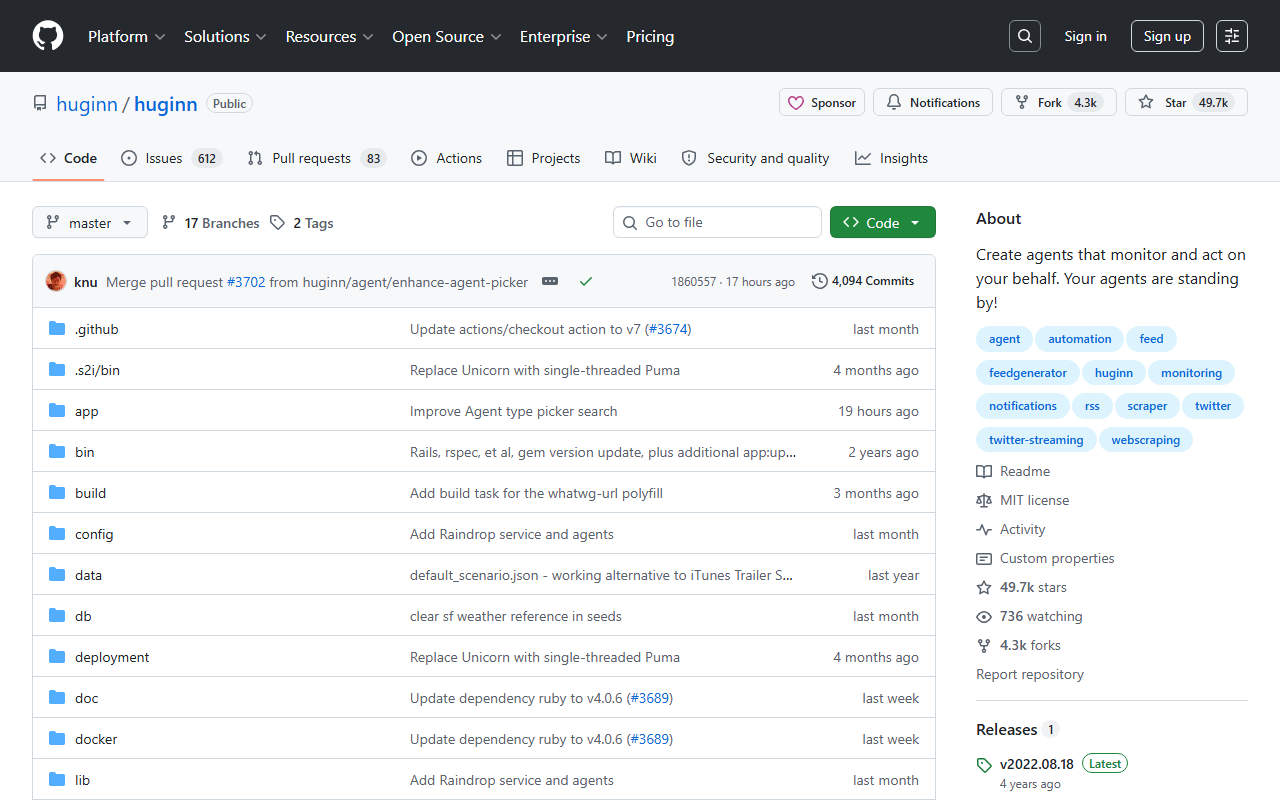
Huginn homepage screenshot

Huginn at a glance

Free plan
Completely free
Free plan score
71/100Strong
Starting price
Free
Open source
MIT
Based in
United States
Company
Huginn (open source project)

Our take

Huginn is the developer's self-hosted answer to IFTTT: MIT-licensed and free forever, excellent for scraping, monitoring, and alerting, with a dated interface and real Ruby on Rails setup as the price.

A decade of agents that watch the web for you

Huginn is a self-hosted system for building agents that act on your behalf online. You configure agents that watch websites, scrape content, monitor feeds, and fire actions when conditions are met. The project describes itself as a hackable version of IFTTT or Zapier that runs on your own server, and that is exactly what it is.

It has been maintained for over a decade, it is MIT-licensed, and it is completely free. Nothing about it is hosted or metered. The trade is that everything is on you: the server, the database, the updates.

Its strengths are monitoring and alerting. If you want to watch a page for changes, track prices, scrape a source, or build a private notification pipeline without handing your data to a SaaS, Huginn is built for exactly that.

The kind of developer Huginn is still built for

  • Developers who want a private, self-hosted agent system with data that never leaves their server
  • Scraping, monitoring, and alerting workflows more than polished app-to-app connectors
  • People who like tinkering and want a hackable, code-friendly automation tool they fully control

Free under MIT, and there is no tier priced above it

As of July 2026 it is MIT-licensed, free for personal and commercial use, and self-hosted only. You get the full agent system with no feature gating and no usage limits beyond what your own server can handle.

There is no cloud version and no paid tier to upsell you, which also means no support desk. You rely on the documentation and the community.

Rails, a database, and the limits of a dated interface

Setup is the barrier. Huginn is a Ruby on Rails application with a MySQL or PostgreSQL database. There is a Docker image, but running it in production means handling updates, backups, and security yourself. This is genuinely developers only.

The interface shows its age. It is functional and config-driven rather than a modern drag-and-drop canvas, so building complex agents means learning how Huginn thinks rather than clicking through a friendly builder.

And its connectors are not the point. If you want one-click integrations with hundreds of SaaS apps, Zapier, Make, or n8n will serve you far better. Huginn is about watching and reacting, not about a broad app catalogue.

A narrow job done well, and free forever

Huginn is a niche tool that does its niche well. If you are a developer who wants a private, self-hosted way to monitor the web and act on it, and you are happy running a Rails app, it is free forever and genuinely yours. If you want a modern builder or broad SaaS connectors, look at n8n or Activepieces instead. Know which job you have before you spend an evening installing it.

What Huginn offers

  • App integrations
  • Self-hosting
  • Code steps
  • Webhooks & API triggers
  • Branching & filters
  • Scheduled triggers
  • Error handling & logs

Not included

  • Visual workflow builder
  • AI & LLM steps
  • Team workspaces

Huginn plans and pricing

Completely free and open source under the MIT License, including commercial use. Self-host only, with no cloud and no paid tier

Huginn is a community-maintained open source project with no company behind it and no hosted edition. Free means free if you can run a Ruby on Rails app with a database

Self-hosted

Free

The full agent system, free for personal and commercial use, installed on your own server

Requires Ruby on Rails and a MySQL or PostgreSQL database; you handle installation, updates, backups, and security yourself

As of July 2026. Check current pricing on the Huginn pricing page.

Huginn's free plan score

How good Huginn's free plan really is, judged on four things and weighted into one number.

71/100

Strong

Free forever and genuinely yours, if running a Rails app is a normal afternoon for you.

Free plan generosity

88/100

Feature depth for the category

48/100

Freedom and honesty

93/100

What free users report

50/100

Scored July 2026. How we calculate the free plan score.

Frequently asked questions about Huginn

Is Huginn free?

Completely. Huginn is open source under the MIT License and free for personal and commercial use, with no paid tier and no hosted edition (as of July 2026). Your only cost is the server you run it on. In exchange, you handle setup and maintenance yourself.

What is Huginn good for?

Watching the web and reacting to it. Huginn agents scrape pages, monitor feeds and websites, track events, and trigger actions like emails, webhooks, or posts. It is strongest for private monitoring and alerting where you want the data on your own server, rather than for slick SaaS-to-SaaS connectors.

How hard is Huginn to set up?

It is a real project. Huginn is a Ruby on Rails application that needs a MySQL or PostgreSQL database, and while there is a Docker image to ease things, keeping it updated, backed up, and secure is ongoing developer work. If you are not comfortable running a Rails app, this is not the tool for you.

Latest Huginn news

Changes that affect what you get for free: pricing, free plan limits, ownership, and whether the project is still maintained. Not every release.

We checked Huginn's own blog, changelog and release notes in July 2026 and found nothing that changes the picture above.

Reader reviews

What people who actually use Huginn think of it.

No reviews of Huginn yet. If you have used it, yours would be the first.

The useful part is the specifics: what you used it for, and where it got in your way.

Loading...