Free alternatives to Kit
Kit's free Newsletter plan holds 10,000 subscribers with no cap on sends (as of July 2026), so people rarely leave because it ran out. They leave for what is missing inside it. There are no integrations at all on free, the automation you get is one basic visual flow that cannot branch, and Kit enables one recommendation slot on your account whose earnings go to Kit. The first paid step is $39 a month for 1,000 subscribers, which is a jump if all you wanted was a Zapier connection. Here is where creators go instead.
Facts checked as of July 2026Read our Kit review
Jump to an alternative




MailerLite
Best Free Alternative ToKitThe closest creator tool, with paid products and a much better editor
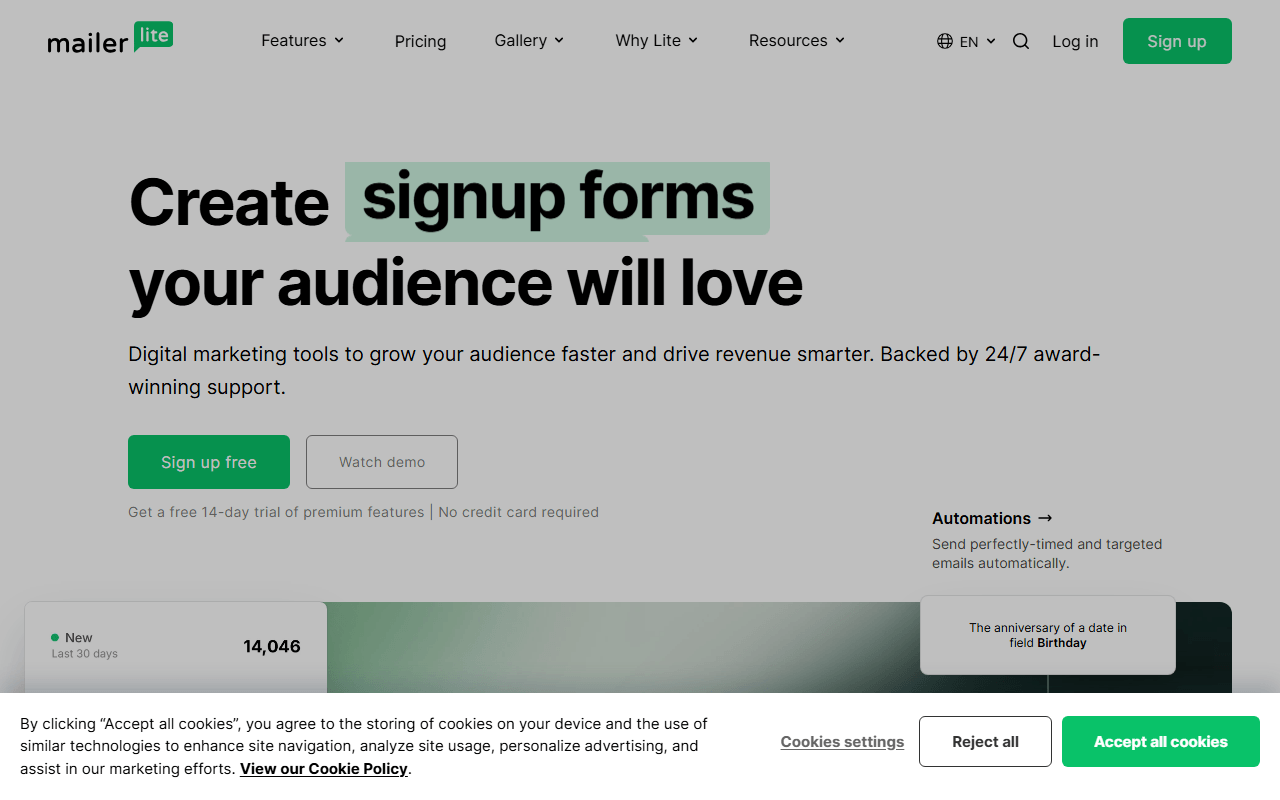
MailerLite is the like-for-like swap for a creator. It sells paid newsletter subscriptions and digital products through Stripe, builds landing pages and forms, and has the best-designed editor in the budget tier, with templates that look right before you touch them. The free plan is where it loses badly: 250 subscribers and 2,500 emails a month, with 3 signup forms, 3 active automations and 1 landing page (as of July 2026). Comfort is $12 a month for 500 subscribers, Power $25.
- Free plan, paid from $12/month (as of July 2026)
- Lithuania
 Lithuania
- Best for:
- Creators who will pay a small amount for a nicer tool with integrations included
- The catch:
- 250 free subscribers against Kit's 10,000 is not a comparison so much as a different plan type. Treat MailerLite's free tier as a trial and budget $12 a month.
Compared to Kit
- Advantage: Integrations are included rather than withheld from free users
- Advantage: 3 active free automations against Kit's single non-branching one
- Worth knowing: Paid newsletters and digital product sales, like Kit
- Advantage: No recommendation slot monetising your audience for the vendor
- Tradeoff: 250 free subscribers against Kit's 10,000
- Tradeoff: 2,500 free emails a month, where Kit's sending is uncapped
- Advantage: Comfort at $12 a month is cheaper than Kit's $39 entry price
Real automation on the free plan, which is the thing Kit holds back
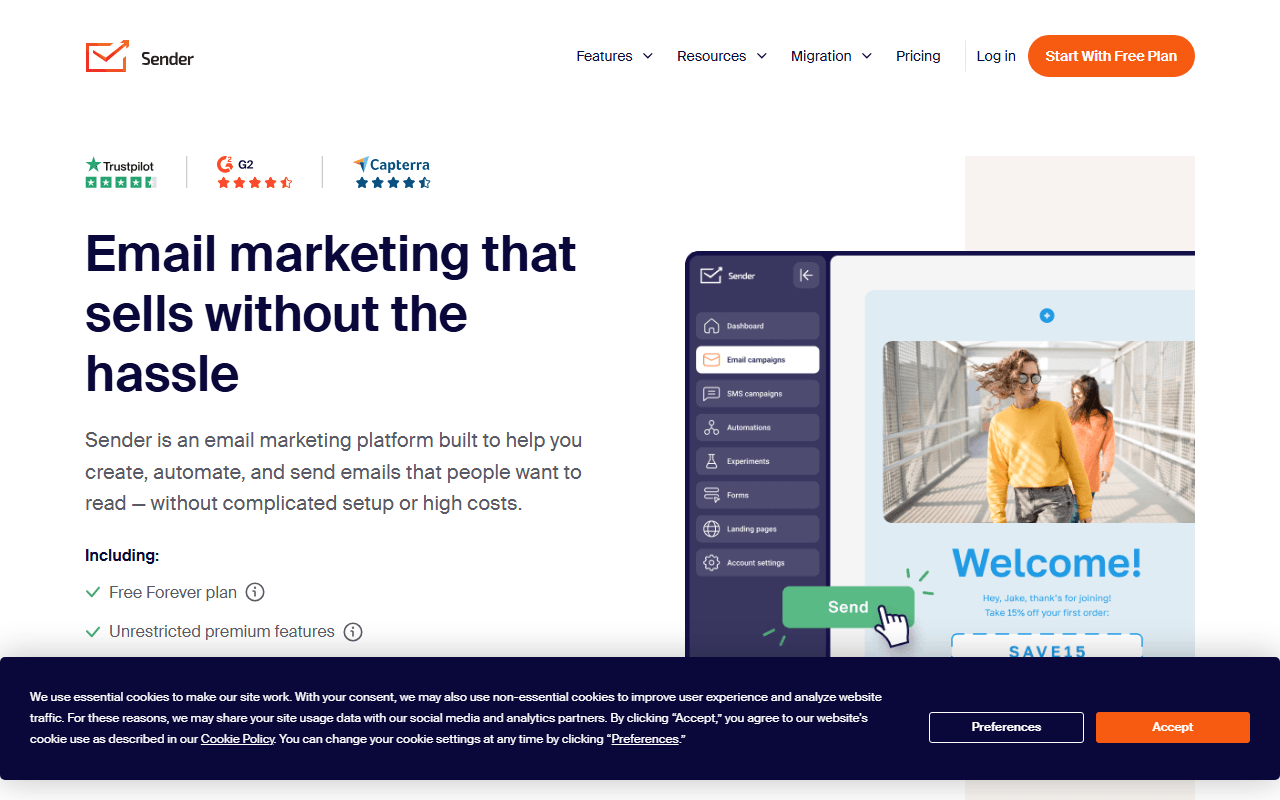
Sender fixes Kit's sharpest free-plan gap. Its Free Forever plan includes automation workflows, landing pages, signup forms and popups rather than reserving them, on 2,500 subscribers and up to 15,000 emails a month spendable as a pool (as of July 2026). If the reason you are looking is that one non-branching automation is not enough to run a welcome series properly, this is the cheapest fix on the list, which is to say free. Paid Standard starts around $7 a month.
- Free plan, paid from $7/month (as of July 2026)
- Lithuania
- Best for:
- Creators who need a proper welcome sequence running without paying $39 a month
- The catch:
- 2,500 subscribers is a quarter of Kit's free allowance and the send pool is finite, so a daily emailer empties it around the middle of the month. Free is also single-seat.
Compared to Kit
- Advantage: Full automation workflows free, against Kit's one basic non-branching flow
- Advantage: Popups and landing pages included on free
- Advantage: Entry paid pricing around $7 a month against Kit's $39
- Advantage: No vendor-owned recommendation slot on your account
- Tradeoff: 2,500 free subscribers against Kit's 10,000
- Tradeoff: 15,000 emails a month is a cap, where Kit's sending is unlimited
- Tradeoff: No paid subscriptions or digital product sales
Writer-first, bills on active readers, and never touches your audience
Buttondown is the option for a writer who read the recommendation-slot clause and did not like it. You draft in Markdown, send from your own domain with no vendor badge, and get a hosted archive. It bills on active subscribers rather than every address you hold. Free covers your first 100 subscribers at about one email a day to your full list (as of July 2026), and paid subscriptions are available as a $9 a month add-on. Registered 501(c)(3) nonprofits get 50% off.
- Free plan (as of July 2026)
- United States
 United States
- Best for:
- Solo writers who want a quiet tool and no vendor placements in their newsletter
- The catch:
- 100 free subscribers against Kit's 10,000 is the largest gap on this list, and Buttondown unbundles: analytics, segmentation and paid subscriptions are $9 a month each and automations $29, so a familiar setup stacks up.
Compared to Kit
- Advantage: No forced badge and no vendor recommendation slot, on free
- Advantage: Bills on active subscribers, so cold addresses stop counting
- Advantage: Sends from your own domain from the free plan
- Tradeoff: 100 free subscribers against Kit's 10,000
- Tradeoff: About one email a day at published prices, where Kit is uncapped
- Tradeoff: Analytics, segmentation and automations are separate paid add-ons
- Tradeoff: No landing pages, popups or visual builder
2,500 free subscribers with integrations and automation switched on
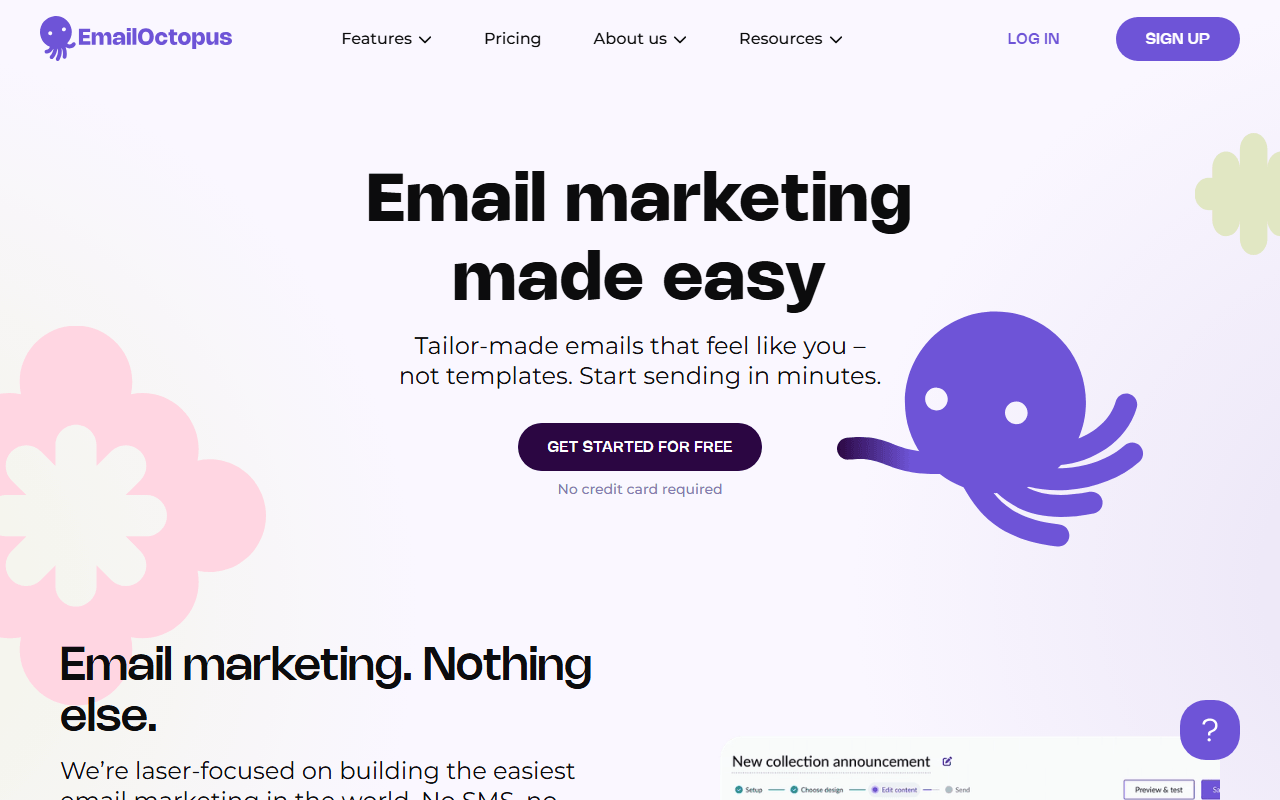
EmailOctopus is a deliberately small newsletter tool from a bootstrapped London company, and its free plan gives you campaigns, automation, landing pages and signup forms on 2,500 subscribers and 10,000 emails a month (as of July 2026), without holding integrations back. Its distinctive trick is EmailOctopus Connect, which routes sending through your own Amazon SES account at near-wholesale rates. Pro starts at $9 a month billed annually.
- Free plan, paid from $9/month (as of July 2026)
- United Kingdom
 United Kingdom
- Best for:
- Newsletter writers who want a plain tool with nothing withheld from the free tier
- The catch:
- Subscribers and monthly sends are counted separately, so a daily email to a full list hits the 10,000 cap while sitting inside the subscriber limit, and there are no paid-subscription or membership features at any price.
Compared to Kit
- Advantage: Automation and integrations available rather than withheld from free
- Advantage: Pro from $9 a month billed annually against Kit's $39
- Advantage: Amazon SES routing gets very cheap at high volume
- Tradeoff: 2,500 free subscribers against Kit's 10,000
- Tradeoff: 10,000 emails a month is a cap, where Kit does not meter sending
- Tradeoff: No paid newsletters, digital products or creator storefront
Holds up to 100,000 contacts free, ten times Kit's ceiling
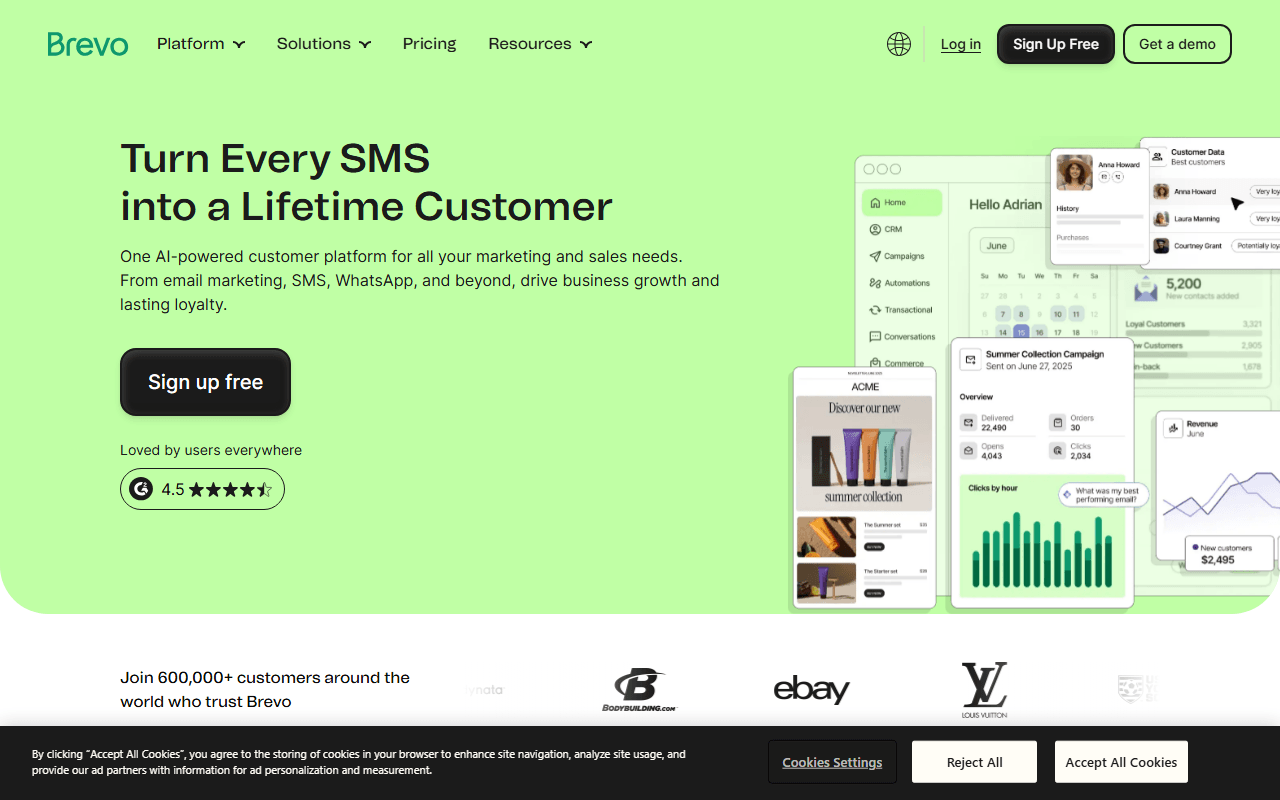
Brevo is the answer when your list has grown past what Kit will hold for nothing. It stores up to 100,000 contacts for free and charges only for emails sent, so list growth never raises your bill by itself. The free plan includes the drag-and-drop builder, signup forms, basic automation, a CRM and transactional sending, at 300 emails a day, about 9,000 a month. Paid Starter begins at $9 a month for 5,000 emails (as of July 2026).
- Free plan, paid from $9/month (as of July 2026)
- France
 France
- Best for:
- Creators whose list passed 10,000 and who send to it infrequently
- The catch:
- The sending model inverts Kit's completely: Kit does not meter sends at all, Brevo caps you at 300 a day, so one issue to 10,000 readers is not possible on free. Brevo also has no paid-subscription or digital product features.
Compared to Kit
- Advantage: Up to 100,000 free contacts against Kit's 10,000 subscribers
- Advantage: Basic automation on free with no branching restriction
- Advantage: Integrations and transactional sending available on free
- Tradeoff: 300 emails a day, where Kit's free sending is unlimited
- Tradeoff: No paid newsletters, digital products or creator profile
- Tradeoff: Removing Brevo branding is a paid add-on even on the $9 Starter plan
The only option here with no subscriber ceiling at all
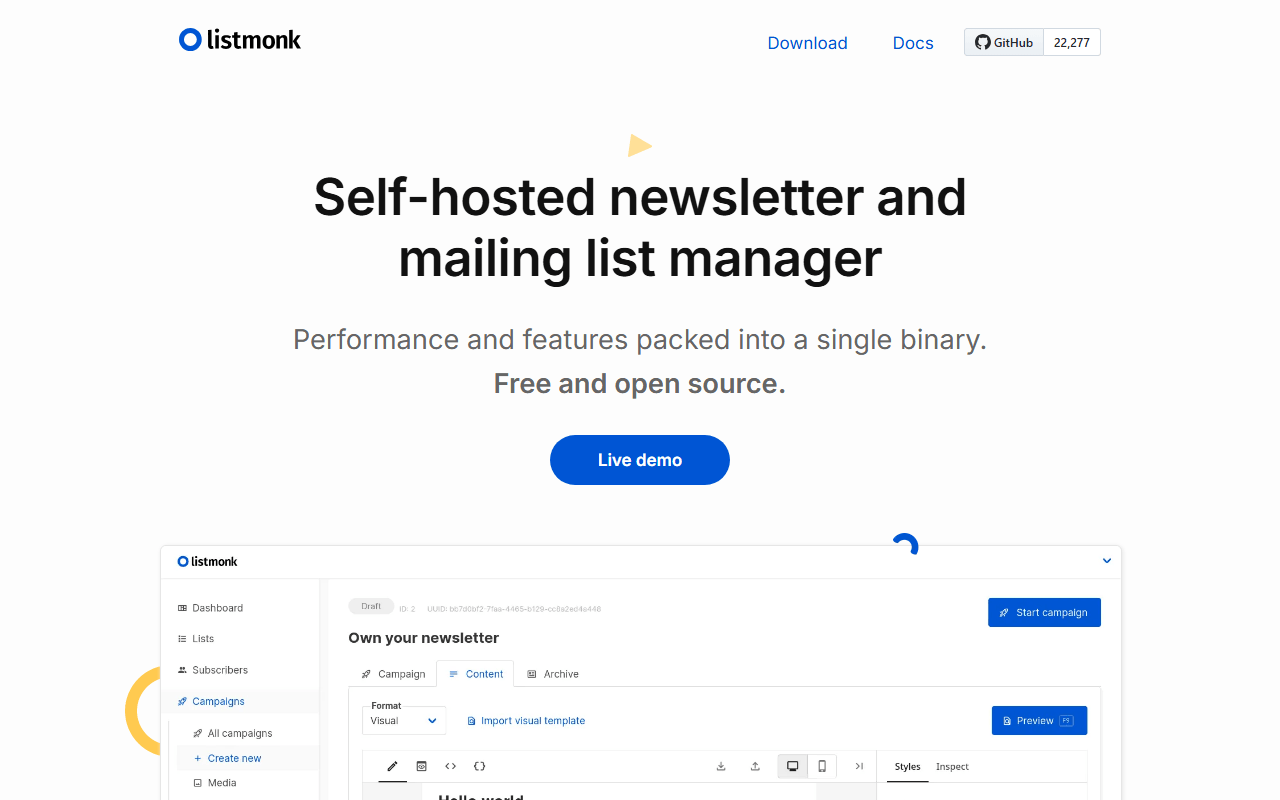
If your list is past 10,000 and you would rather not start paying, listmonk is the honest alternative. It is a self-hosted AGPL-3.0 mailing list manager in a single Go binary against Postgres, with no subscriber cap and no send cap, and it is fast enough that the project documents a seven million email campaign on under one CPU core. Nobody puts a badge on your emails and nobody takes a recommendation slot.
- Completely free (as of July 2026)
- India
- Open source (AGPL-3.0)
 India
India- Best for:
- Technical creators with a big list who want no caps and no vendor in the middle
- The catch:
- listmonk does not deliver mail. You supply and pay an SMTP provider such as Amazon SES, Postmark or Mailgun, plus a small server, and SPF, DKIM, bounces and blocklists become your job. There are also no landing pages and no way to sell a digital product.
Compared to Kit
- Advantage: No subscriber cap at all, where Kit stops free at 10,000
- Advantage: No badge on your emails and no vendor-owned recommendation slot
- Advantage: Your subscriber list is a Postgres table you own outright
- Tradeoff: You own deliverability, the SMTP bill and every bounce
- Tradeoff: No landing pages, forms designer, paid products or creator profile
- Tradeoff: Segmentation is written in SQL rather than tags
Deeper reporting and integrations, at a much smaller free plan
Mailchimp is on this list for completeness rather than as a saving. It is the most complete platform in the category, with mature reporting, a very large integration catalogue and genuinely good customer journeys, and it is the obvious move if your creator business has turned into a shop. On the free question it goes the wrong way: 250 contacts and 500 emails a month, capped at 250 a day (as of July 2026), against Kit's 10,000 subscribers and unmetered sending. Essentials starts at $13 a month.
- Free plan, paid from $13/month (as of July 2026)
- United States
- Best for:
- Creators whose business is now ecommerce and who need store integrations
- The catch:
- You pay for every contact, unsubscribed and inactive included, unless you archive them, and the free plan has been cut from 2,000 to 500 to 250, so almost nobody leaves Kit for Mailchimp to save money.
Compared to Kit
- Advantage: Deep reporting, ecommerce journeys and a very large integration catalogue
- Advantage: Integrations are not withheld from paying users the way Kit withholds them on free
- Tradeoff: 250 free contacts and 500 emails against Kit's 10,000 and unlimited
- Tradeoff: Priced on total contacts, inactive addresses included
- Tradeoff: Free plan has been reduced twice
- Tradeoff: No paid newsletters, digital products or creator profile
How to choose
Work out which missing piece is actually blocking you. If it is integrations, almost anything here fixes that for less than $39 a month, and Sender or EmailOctopus fix it for nothing. If it is automation you need, Sender includes real workflows on its free plan and MailerLite gives you three. If you sell to your readers, MailerLite and Buttondown both do paid subscriptions, though Buttondown charges $9 a month for the feature. If your list is already past 10,000, nothing free here matches Kit, so the honest options are paying Kit or self-hosting listmonk with your own SMTP provider.