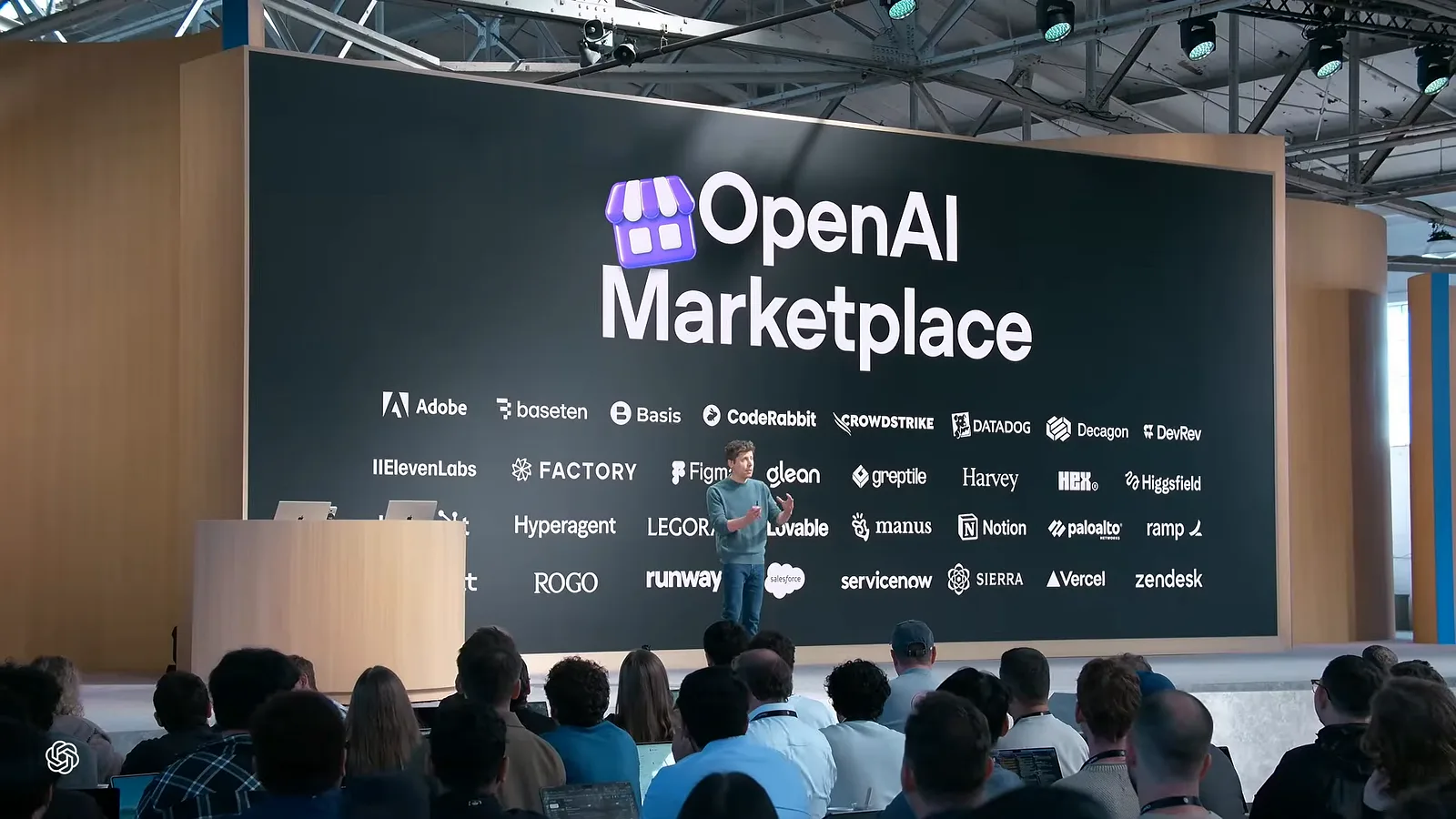
Big companies that buy OpenAI often sign a commitment: an agreement to spend a set amount with OpenAI over a period. As of 29 September 2026, they can put part of that money toward other companies' software. OpenAI calls the program OpenAI Marketplace, and it launched at DevDay with 32 partners listed.
For a software company, the pitch is simple. If your buyer has already budgeted money for OpenAI, buying your product may no longer need a new budget line. Below is what the program is, who it suits, and what applying involves, taken from OpenAI's own pages and the keynote.
What OpenAI launched
The Marketplace page describes it in one line: "OpenAI Marketplace helps enterprise customers discover partner products and use part of their existing OpenAI commitment toward eligible products."
On stage, OpenAI framed it as a sales channel for you, not a store for consumers: "We want to make it easier to sell your product to more businesses. So today we're launching the OpenAI Marketplace." The keynote added two details the page does not spell out:
- Companies that sell through the Marketplace can spend their own OpenAI commitment there too.
- Through a partnership with Baseten, customers "can even access open source models in the marketplace starting today."
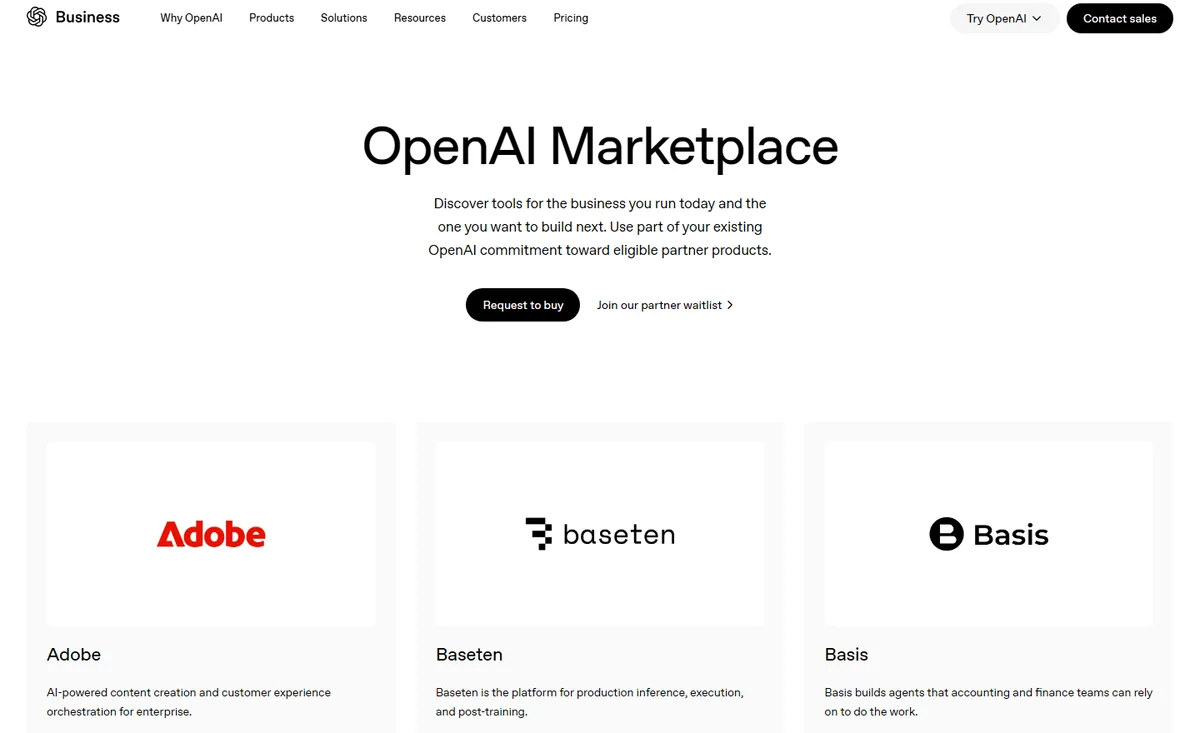
The launch partners, as listed on 29 September 2026: Adobe, Baseten, Basis, CodeRabbit, CrowdStrike, Datadog, Decagon, DevRev, ElevenLabs, Factory, Figma, Glean, Greptile, Harvey, Hex, Higgsfield, HubSpot, Hyperagent, Legora, Lovable, Manus, Notion, Palo Alto Networks, Ramp, Replit, Rogo, Runway, Salesforce, ServiceNow, Sierra, Vercel and Zendesk. That list goes well past AI startups. Security, finance, legal and customer service software are all there.
This is not the plugin directory
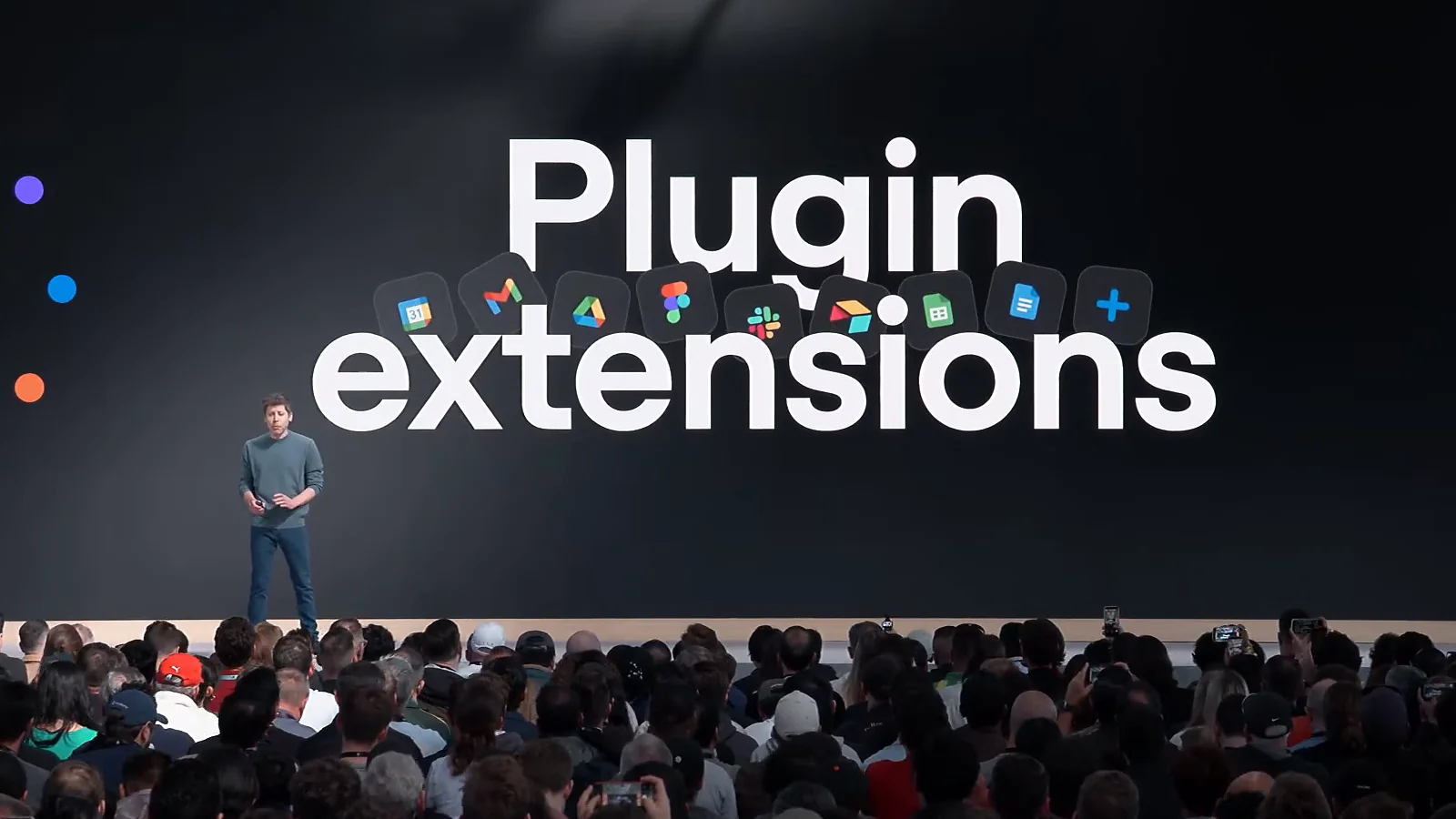
The same keynote announced plugin extensions and new ways for plugins to get discovered inside ChatGPT. The Marketplace is a different thing. Plugins are about distribution inside ChatGPT. The Marketplace is about procurement: how an enterprise pays for your product. You can do one without the other.
How buying works
The FAQ answers the question most sales teams will ask first. "You contract with and pay the partner directly; OpenAI reconciles use of your commitment under the program's terms."
So you keep the customer contract and the billing relationship. OpenAI's role is to let the buyer count that spend against their commitment.
Eligibility is set case by case. In OpenAI's words, it "depends on your OpenAI agreement, the partner product and the program's terms", and "not every product from a listed partner qualifies." Buyers are told to contact OpenAI to confirm what they can spend.
Who should apply
The Marketplace suits you if you sell to large companies and your buyers are likely to have an OpenAI enterprise agreement. It matters less if you sell mostly to small teams on self-serve plans, since the whole mechanism runs through enterprise commitments.
The partner form hints at what OpenAI weighs. It asks for your OpenAI Organization ID (required), and for the share of your product's "production model inference tokens served by OpenAI", in bands from 0-25% to 75-100%. The form does not say how that answer is used. Our reading, which OpenAI has not confirmed: products built on OpenAI's models are the natural fit, but the answer is a band rather than a yes or no, and the launch list includes Baseten, an inference platform for other models.
How to join, in brief
- Get your Organization ID from your OpenAI platform account. The form requires one, so you need an OpenAI API organization before you apply.
- Fill in the partner interest form: company, work email, the product you want to list, the OpenAI share of its inference, and a description of the product and your interest.
- Add your OpenAI contact if you have an account or partnerships manager. It is optional.
- Wait for review. "Submitting expresses interest. Participation is subject to review."
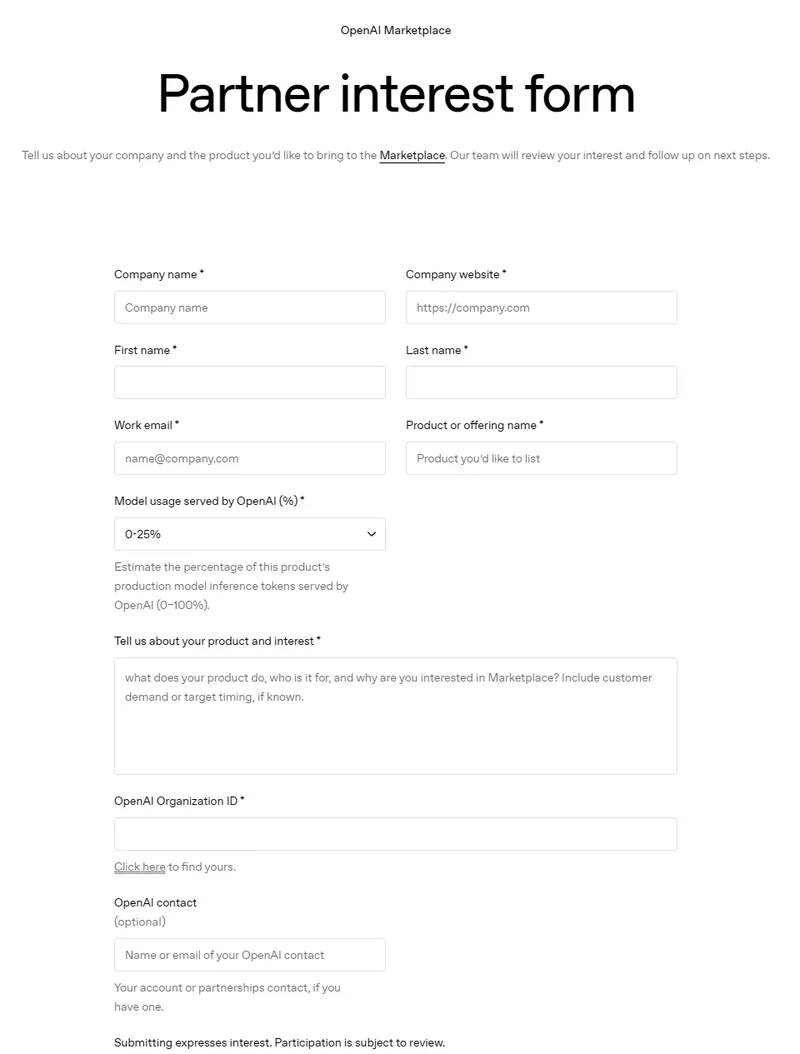
In the description field, OpenAI asks what your product does, who it is for, and why you want in, and to "include customer demand or target timing, if known." If enterprise customers are already asking to buy you with OpenAI budget, say so there.
The catches
- It is a waitlist, not a sign-up. The page says "join our waitlist" and "participation is subject to eligibility and approval." No criteria are published.
- Eligibility is per product. Getting in once does not make your whole catalogue eligible.
- It only helps with commitment holders. A buyer without an OpenAI commitment gains nothing new from the listing.
- You are listed next to your rivals. Several partners overlap: Glean, Notion and Manus each describe themselves on the page as an AI platform, workspace or agent. Being listed gets you in front of buyers, not ahead of competitors.
What we do not know yet
OpenAI publishes no fee or revenue share for partners, no eligibility criteria, and no review timeline. It does not say which regions the program covers, or how "reconciles" works in practice between you, the buyer and OpenAI. We will update this article when OpenAI publishes the program terms, and note the change at the bottom.