Free alternatives to Buttondown
Buttondown is a lovely place to write, but its free plan stops at 100 subscribers and at most one email a day to your full list (as of July 2026), so it runs out fast. The bigger surprise is the bill: Buttondown prices a cheap base product and sells the rest a la carte, so analytics, segmentation, and paid subscriptions are $9 a month each and automations $29, and a setup that felt simple stacks up. If you have outgrown the 100-subscriber cap, or you want features bundled instead of billed one at a time, these tools give you more room.
Facts checked as of July 2026Read our Buttondown review
Jump to an alternative



EmailOctopus
Best Free Alternative ToButtondownThe same simple, newsletter-only tool, but 2,500 free subscribers and 10,000 emails a month
EmailOctopus keeps email deliberately small the way Buttondown does, with no CRM or marketing suite, but the free plan covers 2,500 subscribers and 10,000 emails a month, and features come bundled rather than sold as $9-a-month add-ons. Its distinctive feature is EmailOctopus Connect, which routes your sending through your own Amazon SES account so you pay near-wholesale rates. Pro starts at $9 a month billed annually and scales with subscriber count.
- Free plan, paid from $9/month (as of July 2026)
- United Kingdom
 United Kingdom
- Best for:
- Writers who love Buttondown's simplicity but have outgrown 100 subscribers
- The catch:
- Subscribers and monthly sends are two separate limits, so a small list on a daily email can hit the 10,000-send cap while inside the 2,500-subscriber cap. Emails carry EmailOctopus branding on the free plan, where Buttondown lets you send from your own domain.
Compared to Buttondown
- Advantage: 2,500 free subscribers versus Buttondown's 100
- Advantage: 10,000 free emails a month versus Buttondown's roughly one send a day
- Advantage: Features bundled in, not sold as $9-a-month add-ons
- Advantage: Amazon SES routing gets very cheap at high volume
- Tradeoff: Free plan puts EmailOctopus branding on emails; Buttondown sends from your own domain free
- Tradeoff: No Markdown-first writing; the editor is a basic visual one
- Worth knowing: Pro pricing scales with subscriber count
The biggest free plan here, 2,500 subscribers and 15,000 emails a month, automation included
Sender hands out the largest free tier in this category: 2,500 subscribers and 15,000 emails a month, with automation, landing pages, signup forms, and popups included rather than sold separately the way Buttondown sells its add-ons. The editor is a conventional drag-and-drop rather than Buttondown's Markdown. Paid Standard starts around $7 a month and scales with your subscriber count.
- Free plan, paid from $7/month (as of July 2026)
- Lithuania
 Lithuania
- Best for:
- People who want the most free headroom and features bundled, not billed a la carte
- The catch:
- The drag-and-drop editor is a different experience from Buttondown's writer-first Markdown, and the free plan is single-seat.
Compared to Buttondown
- Advantage: 2,500 free subscribers versus Buttondown's 100
- Advantage: 15,000 free emails a month versus Buttondown's roughly one send a day
- Advantage: Automation, landing pages, and popups included, not $9-to-$29 add-ons
- Advantage: Entry paid pricing around $7 a month
- Tradeoff: Conventional drag-and-drop editor, not Markdown writing
- Tradeoff: Free plan is single-seat
- Tradeoff: Emails carry Sender branding, where Buttondown sends from your own domain free
A nicer editor and native paid subscriptions, without buying them as add-ons
MailerLite has the best-designed editor in the budget tier, and it supports paid newsletter subscriptions and digital product sales natively, where Buttondown charges $9 a month to switch paid subscriptions on. The free plan is smaller though: 250 subscribers and 2,500 emails a month, with 3 signup forms and 3 active automations. Paid Comfort starts at $12 a month for 500 subscribers.
- Free plan, paid from $12/month (as of July 2026)
- Lithuania
- Best for:
- Creators who want good-looking emails and built-in paid subscriptions
- The catch:
- The free plan stops at 250 subscribers and 2,500 emails a month, only a modest step up from Buttondown's 100, so you will likely be on $12 a month before long.
Compared to Buttondown
- Advantage: 250 free subscribers versus Buttondown's 100
- Advantage: 2,500 free emails a month versus Buttondown's roughly one send a day
- Advantage: Paid subscriptions and digital product sales built in, not a $9 add-on
- Advantage: Cleaner visual editor and templates
- Tradeoff: No Markdown-first writing mode
- Tradeoff: Free plan caps you at 3 signup forms and 3 active automations
- Worth knowing: Priced on subscriber count, so a big list gets expensive
Never charges for the size of your list, up to 100,000 contacts free
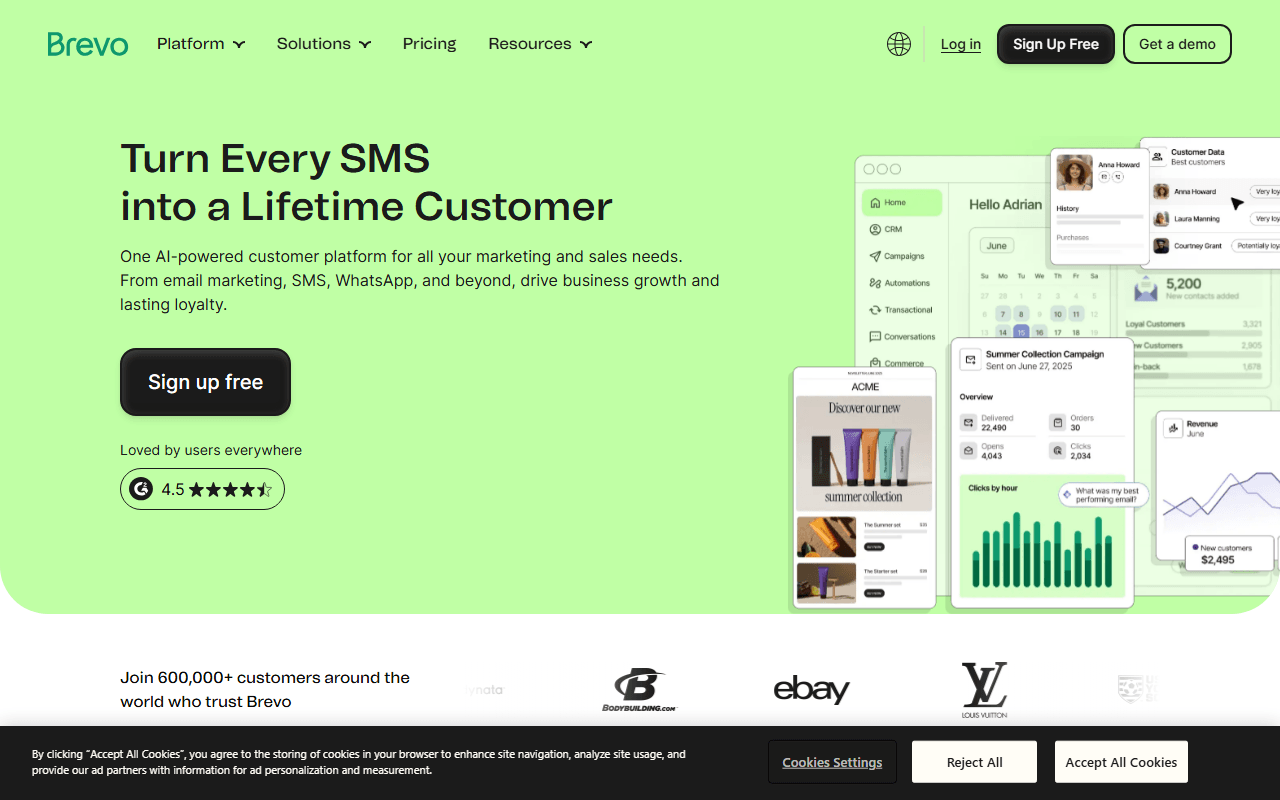
Brevo is the opposite of Buttondown's active-subscriber billing: it never charges for stored contacts at all, holding up to 100,000 for free, and prices only on emails sent. The free plan covers 300 emails a day, roughly 9,000 a month, and bundles the builder, forms, basic automation, a CRM, and transactional email. Paid Starter begins at $9 a month for 5,000 emails.
- Free plan, paid from $9/month (as of July 2026)
- France
 France
- Best for:
- People building a large list who want neither per-subscriber nor a la carte billing
- The catch:
- The free plan's 300 is a daily ceiling, not a monthly pool, and the interface spanning email, SMS, CRM, and chat is a long way from Buttondown's calm.
Compared to Buttondown
- Advantage: Up to 100,000 free contacts versus Buttondown's 100
- Advantage: Roughly 9,000 free emails a month versus Buttondown's one send a day
- Advantage: Automation and forms bundled free, not sold as add-ons
- Advantage: Marketing and transactional email from one account
- Tradeoff: Daily 300-email cap blocks one-off blasts to a big list for free
- Tradeoff: Busy suite interface, unlike Buttondown's writer-first calm
- Tradeoff: Removing Brevo branding is a paid add-on even on Starter
One product for marketing and transactional email, if you are building a SaaS not just a newsletter
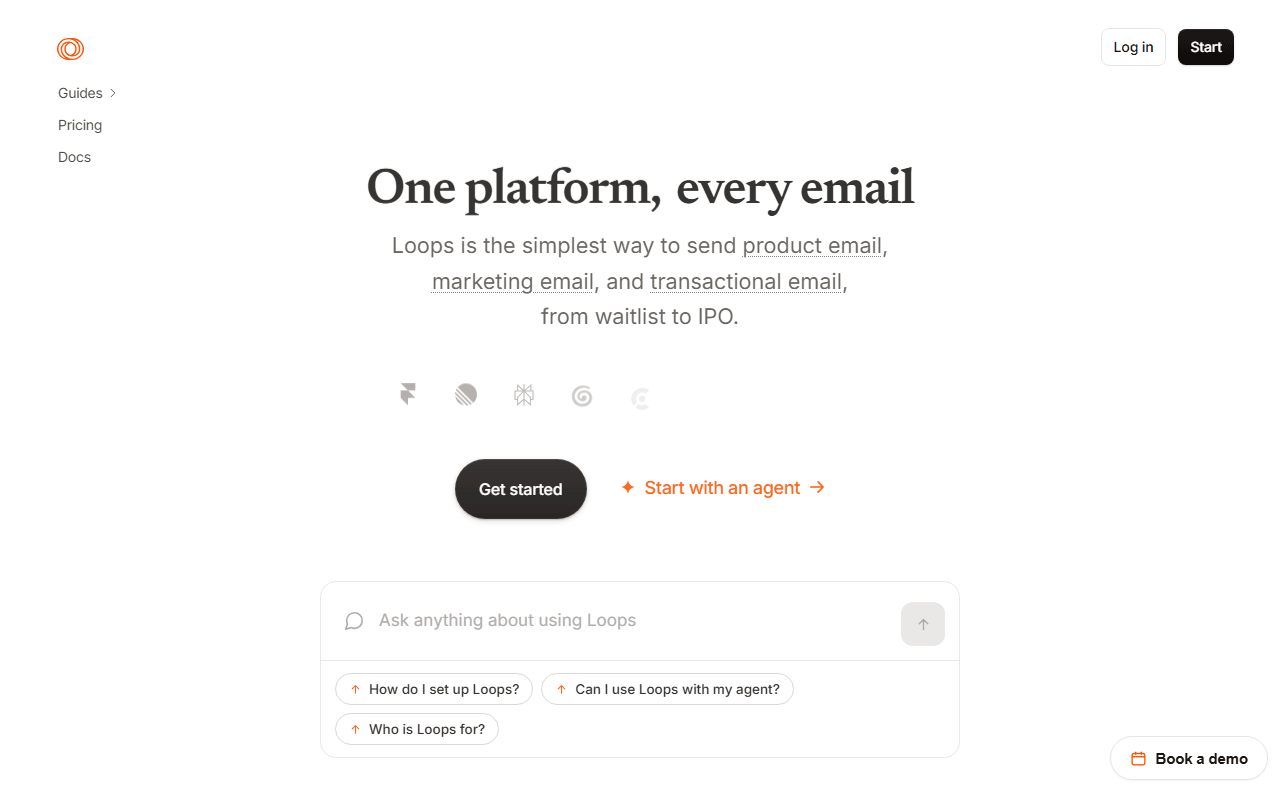
Loops suits the Buttondown user who has started shipping a product and now needs onboarding emails and receipts, not just a newsletter. Marketing campaigns, automated sequences, and transactional email share one contact record, and every feature sits on one plan with no a la carte add-ons. The free plan covers under 1,000 contacts and 4,000 sends per 30 days. The paid plan is $49 a month for 5,000 contacts with unlimited sends.
- Free plan, paid from $49/month (as of July 2026)
- United States
 United States
- Best for:
- Writers who are now building a software product and need transactional email too
- The catch:
- The jump from free to $49 a month is the steepest in this category, with nothing in between, and transactional sends count against the free plan's 4,000 allowance.
Compared to Buttondown
- Advantage: Under 1,000 free contacts versus Buttondown's 100
- Advantage: 4,000 free sends per 30 days versus Buttondown's one send a day
- Advantage: Every feature on one plan, no a la carte add-ons
- Advantage: Marketing and transactional email on one contact record
- Tradeoff: First paid tier is $49 a month, a steep single jump
- Tradeoff: No Markdown writer experience; built around product events
- Tradeoff: Loops branding on free-plan emails, where Buttondown uses your own domain
Self-hosted and open source, with no subscriber or sending limits at all
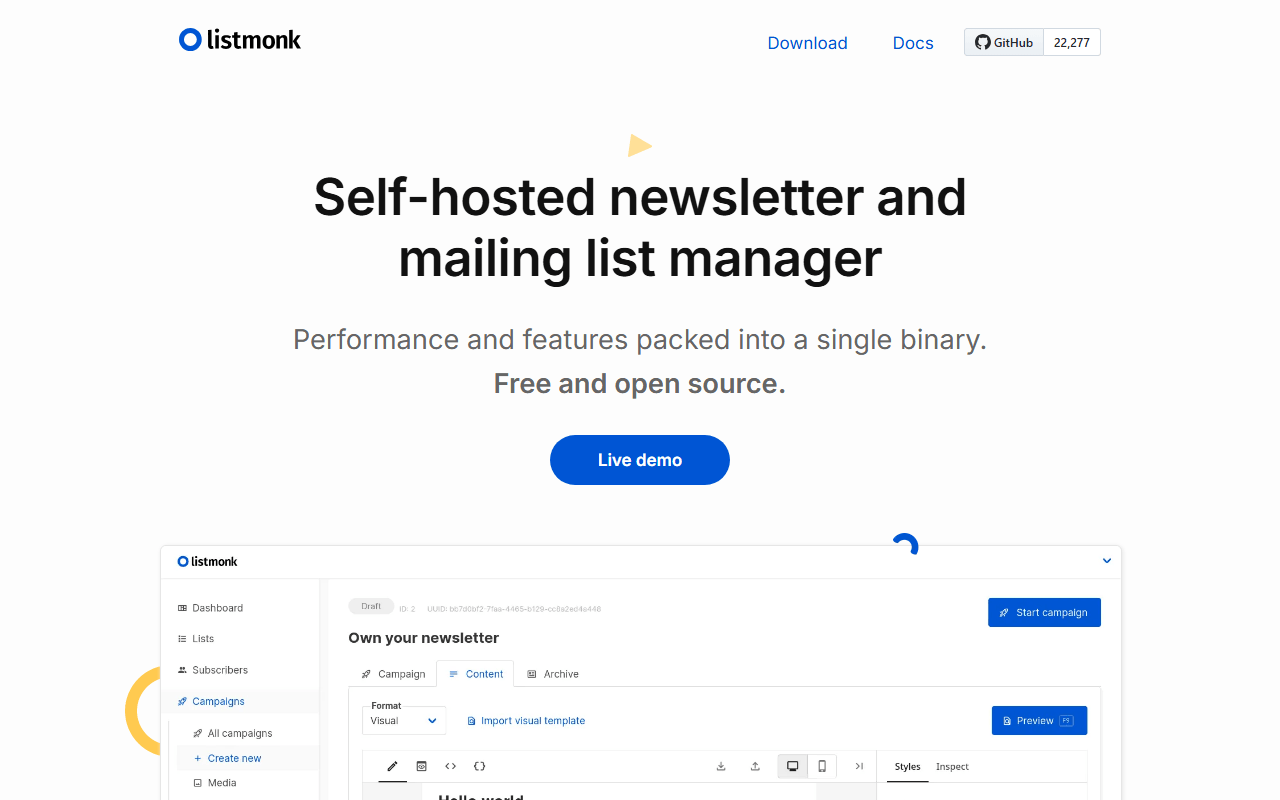
listmonk appeals to the Buttondown user who wants to own everything: a single Go binary and a Postgres database, AGPL-3.0 licensed, with no subscriber or send caps and no vendor branding. It handles subscribers, SQL segmentation, templates, and campaigns. The honest catch is that listmonk does not deliver email, so you supply and pay an SMTP provider such as Amazon SES, plus a small server, and you own deliverability.
- Completely free (as of July 2026)
- India
- Open source (AGPL-3.0)
 India
India- Best for:
- Technical writers who want no limits and full ownership of their list and data
- The catch:
- Free means free software, not free sending. You run the server, pay an SMTP provider per email, and own SPF, DKIM, bounces, and blocklists yourself.
Compared to Buttondown
- Advantage: No subscriber or send limits versus Buttondown's 100 subscribers and one send a day
- Advantage: Your subscriber list is a Postgres table you own outright
- Advantage: No vendor branding and no a la carte add-ons
- Tradeoff: Requires a server, Postgres 12+, and DNS configuration
- Tradeoff: You supply and pay an SMTP provider, and own deliverability
- Tradeoff: No Markdown-first writing flow or hosted archive out of the box
The most complete platform, if you want ecommerce features Buttondown never had
Mailchimp is here as the full-suite contrast: a mature builder, deep reporting, a huge integration catalogue, and strong customer journeys. Its free plan is 250 contacts and 500 emails a month, capped at 250 a day, and paid plans price on total contacts including people who never open. Essentials starts at $13 a month.
- Free plan, paid from $13/month (as of July 2026)
- United States
- Best for:
- Writers moving into ecommerce who need Shopify integrations and customer journeys
- The catch:
- You pay for every contact, inactive included, and the free plan of 250 contacts and 500 emails a month is only a small step past Buttondown's 100.
Compared to Buttondown
- Advantage: 250 free contacts and 500 free emails a month versus Buttondown's 100 and one send a day
- Advantage: Deepest reporting and integration catalogue in the category
- Advantage: Customer journeys and ecommerce features Buttondown lacks
- Tradeoff: Prices on total contacts, inactive included
- Tradeoff: Heavy interface, a long way from Buttondown's calm
- Tradeoff: Free plan has been cut repeatedly
How to choose
Start with two numbers: how many subscribers you store and how many emails you send a month, because free plans cap both and Buttondown's real limit is the tiny subscriber count. If you want the same calm, newsletter-only feel with far more headroom, EmailOctopus covers 2,500 subscribers and 10,000 emails a month with features included rather than sold separately. If you want the largest free plan with automation built in, Sender covers 2,500 subscribers and 15,000 emails a month. Pay MailerLite $12 a month only if a nicer editor and native paid subscriptions are worth it, and look at listmonk only if running your own server and SMTP provider sounds fine.