Free alternatives to Mailchimp
Mailchimp bills you on contacts, and the count includes people who unsubscribed or have not opened anything in two years, so your invoice grows even when your sending does not. The free plan has been cut from 2,000 contacts to 500 to 250 contacts and 500 emails a month (as of July 2026), which is barely enough to test with. Add an interface carrying fifteen years of features you will never use, and the reason people leave is not really price alone, it is paying more each year for the same newsletter.
Facts checked as of July 2026Read our Mailchimp review
Jump to an alternative




Brevo
Best Free Alternative ToMailchimpNever charges for contacts, so a big list costs nothing to store
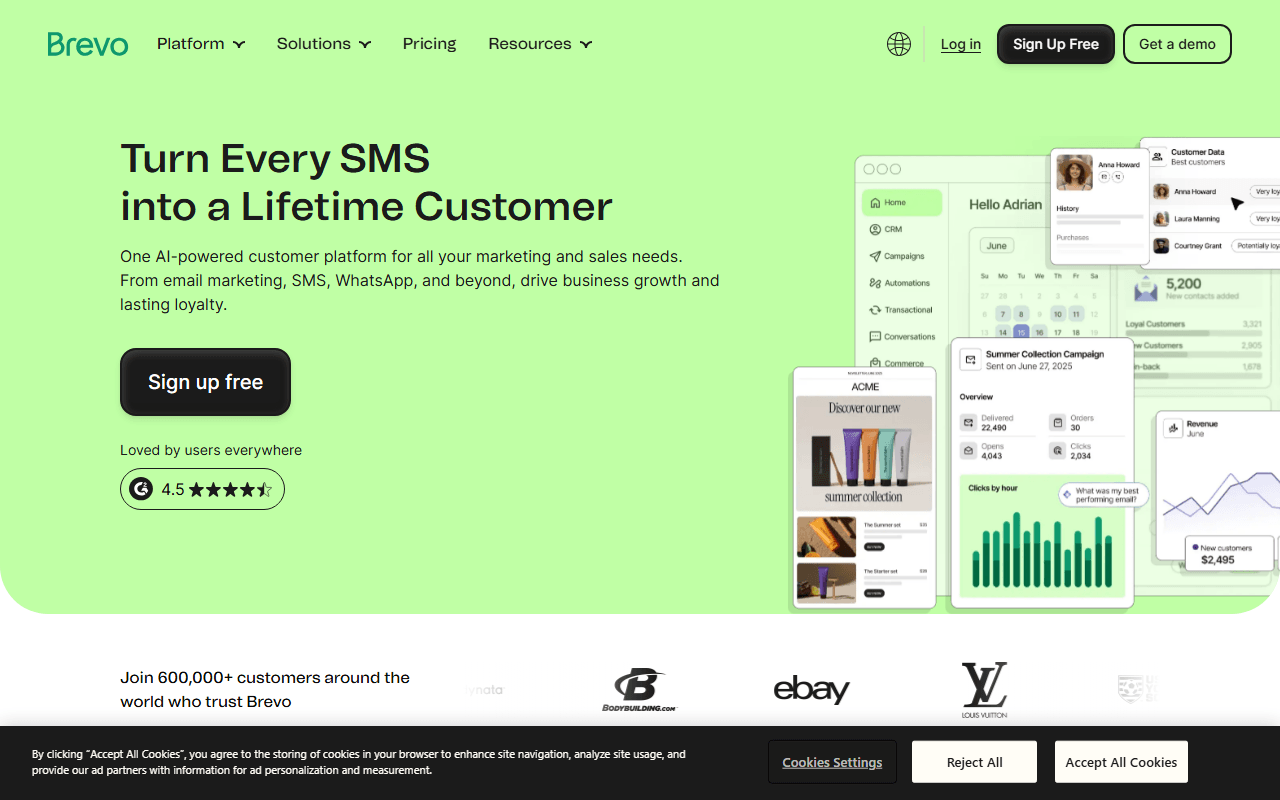
Brevo removes the exact mechanism that makes Mailchimp expensive. You can hold up to 100,000 contacts for free and pay only for emails sent, which means an old list full of quiet subscribers stops being a liability. The free plan covers 300 emails per day, around 9,000 a month, and includes the drag-and-drop builder, signup forms, basic automation, a CRM, and transactional sending. Paid Starter plans begin at $9 a month for 5,000 emails and stay priced by volume.
- Free plan, paid from $9/month (as of July 2026)
- France
 France
- Best for:
- People whose Mailchimp bill grew because their list grew, not their sending
- The catch:
- The free tier's 300 is a daily ceiling, not a monthly pool, so you cannot blast 3,000 people in one afternoon without paying.
Compared to Mailchimp
- Advantage: Up to 100,000 contacts free versus Mailchimp's 250
- Advantage: Priced on emails sent, so inactive subscribers never raise your bill
- Advantage: About 9,000 free emails a month versus Mailchimp's 500
- Advantage: Marketing and transactional email from the same account
- Tradeoff: Daily 300-email cap makes one-off blasts to a big list impossible for free
- Tradeoff: Removing Brevo branding is a paid add-on even on the Starter plan
- Worth knowing: Both interfaces are busy; Brevo spans email, SMS, CRM, and chat
2,500 free subscribers and 15,000 free emails a month, automation included
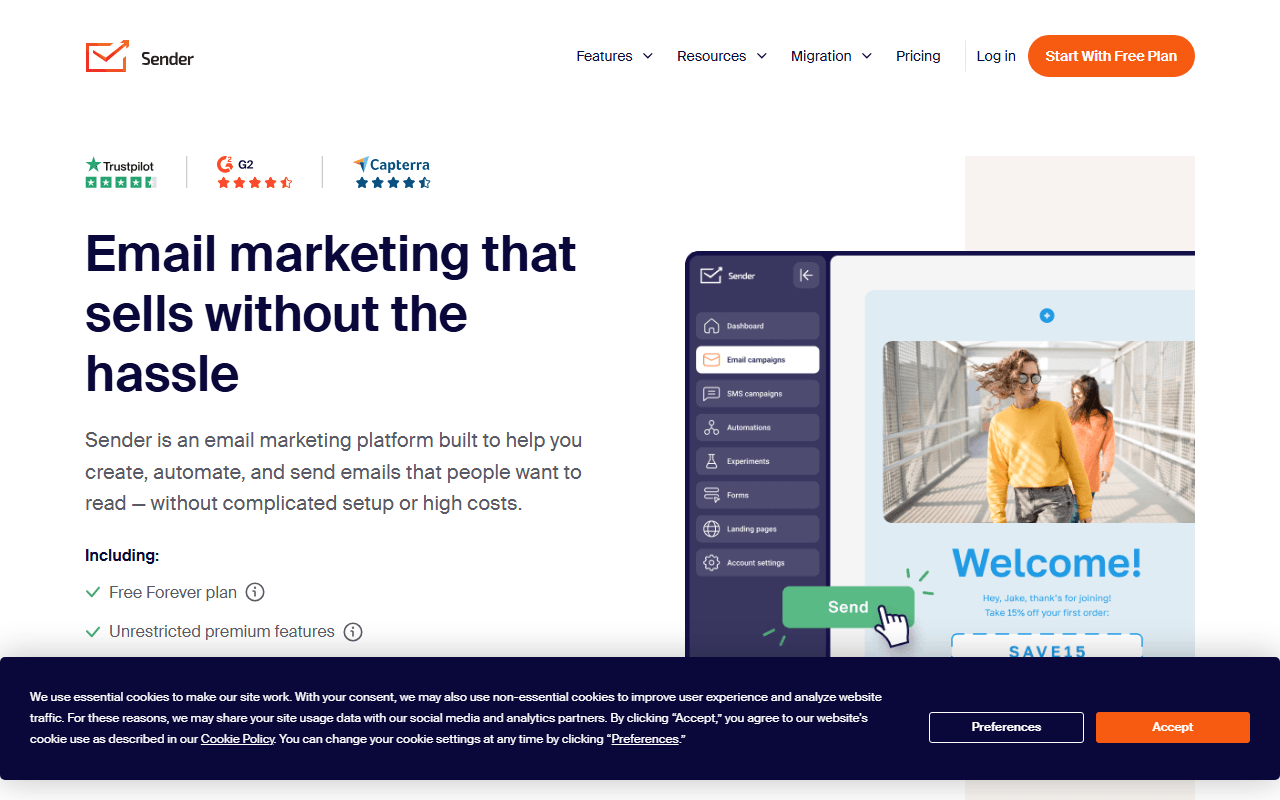
Sender hands out ten times Mailchimp's free contact allowance and thirty times its free sending. The Free Forever plan covers 2,500 subscribers and 15,000 emails a month, and unusually it includes automation workflows, landing pages, signup forms, and popups rather than reserving them for paid tiers. For a list under 2,500 running a weekly newsletter, this is the closest thing to a free replacement for a paid Mailchimp plan.
- Free plan, paid from $7/month (as of July 2026)
- Lithuania
 Lithuania
- Best for:
- Small shops and creators with under 2,500 subscribers who want to pay nothing
- The catch:
- The editor is a clear step behind Mailchimp's and MailerLite's, and the free plan is single-seat so nobody else on your team can log in.
Compared to Mailchimp
- Advantage: 2,500 free subscribers versus Mailchimp's 250
- Advantage: 15,000 free emails a month versus Mailchimp's 500
- Advantage: Automation, landing pages, and popups on the free plan
- Advantage: Entry paid pricing around $7 a month against Mailchimp's $13
- Tradeoff: Email editor and templates are less refined
- Tradeoff: Free plan gives one seat, so no team collaboration
- Tradeoff: Far fewer native integrations than Mailchimp's catalogue
2,500 free subscribers, plus the option to send through your own Amazon SES
EmailOctopus is what Mailchimp looks like with fifteen years of features removed. Free covers 2,500 subscribers and 10,000 emails a month, and Pro starts at $9 a month billed annually. Its distinctive feature is EmailOctopus Connect, which routes your campaigns through your own Amazon SES account so you pay Amazon's raw per-email rate. At high volume that is cheaper than anything priced per subscriber, Mailchimp very much included.
- Free plan, paid from $9/month (as of July 2026)
- United Kingdom
 United Kingdom
- Best for:
- Newsletter writers who want a simple tool, and high-volume senders who can use SES
- The catch:
- Subscribers and monthly sends are counted as two separate limits, so a small list on a daily email can hit the send cap while nowhere near the subscriber cap.
Compared to Mailchimp
- Advantage: 2,500 free subscribers and 10,000 free emails versus 250 and 500
- Advantage: Amazon SES routing gets very cheap at high volume
- Advantage: Pro from $9/month annually undercuts Mailchimp Essentials at $13
- Advantage: Much simpler interface with far less to learn
- Tradeoff: Basic editor, so design-led senders will feel constrained
- Tradeoff: No ecommerce journeys, ad integrations, or predictive segmentation
- Tradeoff: Pro pricing still scales with subscriber count, like Mailchimp's
The nicest editor in the budget tier, at $12 a month instead of $13 for less
MailerLite is where people go when the complaint about Mailchimp is the interface rather than the invoice. The editor is calm, the templates look good without being rescued, and paid plans start at $12 a month for 500 subscribers on the Comfort tier. It also supports paid newsletter subscriptions and digital product sales, which Mailchimp does not. The free plan is the weak point: 250 subscribers and 2,500 emails a month, matching Mailchimp on contacts.
- Free plan, paid from $12/month (as of July 2026)
- Lithuania
- Best for:
- Anyone who cares how their emails look and is willing to pay a small amount
- The catch:
- The free plan has been cut over time and now stops at 250 subscribers with only 3 active automations, so treat it as a trial rather than a destination.
Compared to Mailchimp
- Advantage: 2,500 free emails a month versus Mailchimp's 500
- Advantage: Cleaner editor and templates that need less work
- Advantage: Paid newsletters and digital product sales built in
- Advantage: Comfort at $12/month is cheaper than Essentials at $13 and includes more
- Tradeoff: Same 250-contact free ceiling as Mailchimp
- Tradeoff: Free plan allows only 3 active automations and 3 signup forms
- Worth knowing: Both price on subscriber count, so the scaling problem does not go away
Self-hosted and open source, with no subscriber or sending limits at all
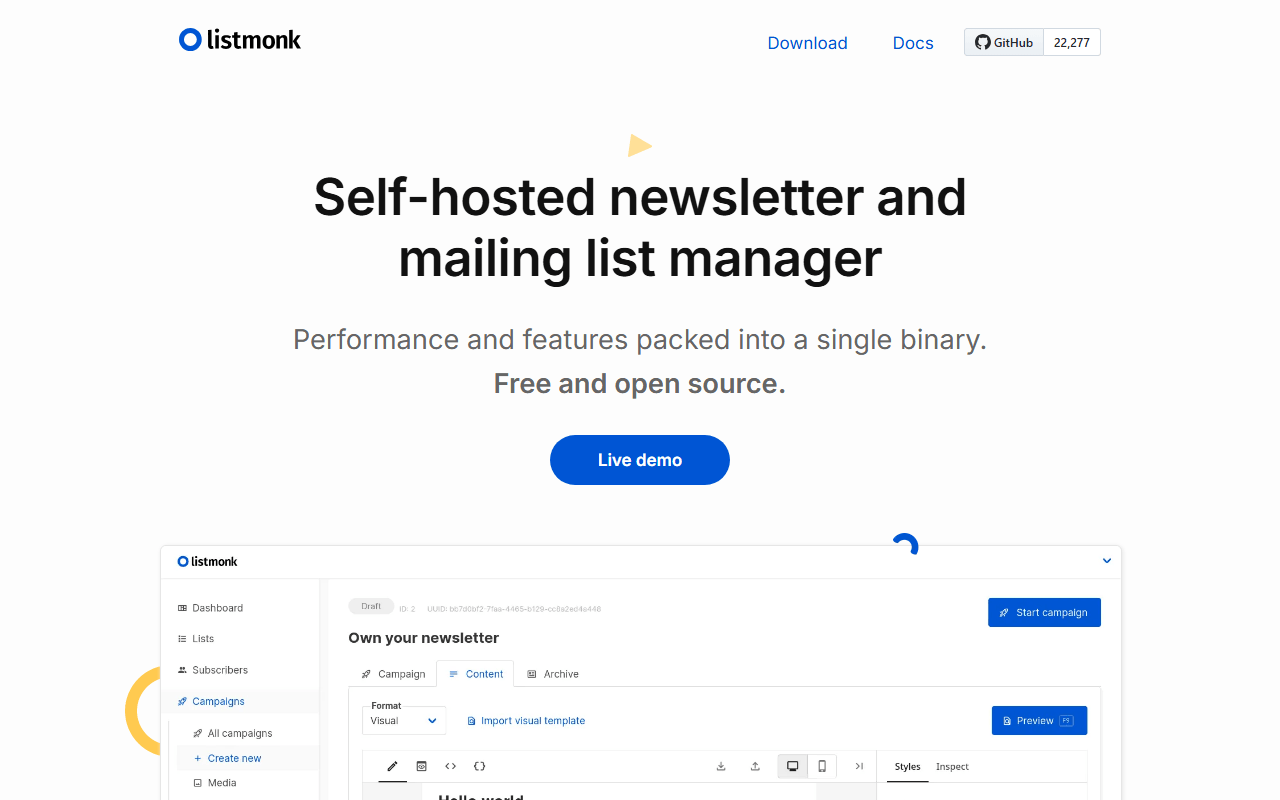
listmonk is a single Go binary and a Postgres database that manages unlimited subscribers, lists, and campaigns under an AGPL-3.0 licence. There is no vendor, so there is no contact-based pricing to escape. It is genuinely fast, with the project documenting a seven million email campaign on under one CPU core. The honest asterisk: listmonk does not deliver email itself, it queues campaigns to SMTP servers you configure, so you still pay Amazon SES, Postmark, or Mailgun per email, plus a small server.
- Completely free (as of July 2026)
- India
- Open source (AGPL-3.0)
 India
India- Best for:
- Technical teams with large lists where per-contact pricing has stopped making sense
- The catch:
- Free means free software, not free email. You own the server, the SMTP bill, and every deliverability problem: SPF, DKIM, bounces, and blocklists all become your job.
Compared to Mailchimp
- Advantage: No subscriber or sending limits, ever
- Advantage: Your subscriber list is a Postgres table you own outright
- Advantage: At scale the SES-plus-VPS cost is a fraction of Mailchimp's
- Tradeoff: Requires a server, Postgres 12+, and DNS configuration
- Tradeoff: Deliverability and sender reputation are entirely your responsibility
- Tradeoff: No landing pages, popups, A/B testing, or ecommerce integrations
- Tradeoff: Support is a GitHub issue tracker, not a helpdesk
Bills only on active subscribers, not everyone sitting in your database
Buttondown attacks Mailchimp's pricing model directly by charging for subscribers who are actually receiving your emails rather than every address you have ever collected. It is a small, writer-first tool: Markdown editor, custom sending domain, hosted archive, and very little else. Free covers your first 100 subscribers, then you pay a base rate on your active list and add features one at a time. Registered nonprofits get 50% off.
- Free plan (as of July 2026)
- United States
 United States
- Best for:
- Personal newsletters and writers starting from zero
- The catch:
- 100 free subscribers is the smallest free tier here, and the pieces Mailchimp bundles are priced separately. Analytics, segmentation, and paid subscriptions are $9 a month each, automations are $29, so a familiar-looking setup stacks up fast.
Compared to Mailchimp
- Advantage: Charges on active subscribers, so dead addresses cost nothing
- Advantage: Markdown editor and custom sending domain from the free plan
- Advantage: Pay only for the features you turn on, if you just write and send
- Advantage: 50% discount for registered 501(c)(3) nonprofits
- Tradeoff: Only 100 free subscribers, well below Mailchimp's 250
- Tradeoff: Analytics, segmentation, and automations are billed as separate add-ons
- Tradeoff: About one email a day at the published prices, so no launch blasts
- Tradeoff: No visual builder, landing pages, or ecommerce features
Marketing and transactional email in one product, with no feature tiers
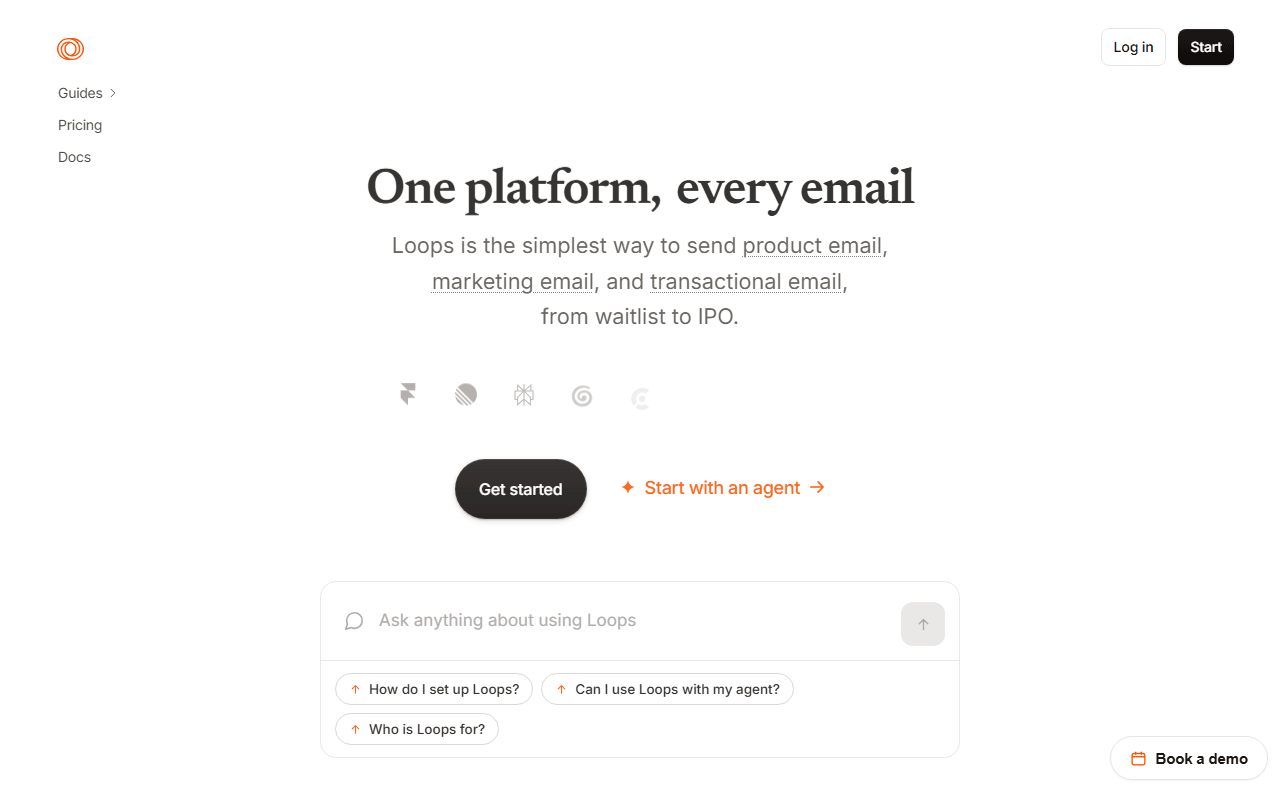
Loops is the pick if you are leaving Mailchimp because you run a software product, not a shop. Campaigns, automated sequences, and transactional email share one contact record, so onboarding emails and receipts come from the same place. There is a single paid plan with every feature, priced only by contact count, which removes the which-tier-unlocks-what guessing that Mailchimp trades on. Free covers under 1,000 contacts and 4,000 sends per 30 days.
- Free plan, paid from $49/month (as of July 2026)
- United States
- Best for:
- SaaS teams replacing a marketing tool and a transactional provider at once
- The catch:
- The step from free to paid is $49 a month for 5,000 contacts with nothing in between, the steepest jump on this list, and Loops has revised its free plan more than once.
Compared to Mailchimp
- Advantage: 1,000 free contacts and 4,000 free sends versus 250 and 500
- Advantage: Transactional email included at no extra charge on paid plans
- Advantage: One plan with all features, no tier puzzles
- Advantage: Team seats are not billed separately
- Tradeoff: First paid tier is $49/month against Mailchimp Essentials at $13
- Tradeoff: No landing pages, popups, or paid-newsletter features
- Tradeoff: Built around products sending events, so pure newsletter writers gain little
How to choose
Write down two numbers first: how many contacts you store, and how many emails you actually send each month. Free plans cap those separately and most people only check the first one. If your list is large but your sending is light, Brevo never charges for contacts. If your list is under 2,500, Sender gives you the most room for nothing. If you care how the emails look, pay MailerLite $12 a month rather than fighting a weaker free tier, and only consider self-hosting listmonk if configuring DNS records sounds like a normal Tuesday.