Free alternatives to Zapier
Zapier's free plan caps you at 100 tasks a month and two-step Zaps, one trigger and one action, so the first useful automation with a filter or a second action already pushes you toward paid (as of July 2026). From there Professional starts at $19.99 a month and climbs with task volume, and because Zapier counts a task for every step of every run, a busy multi-step workflow burns through your allowance fast. The tool is excellent and the connectors are unmatched. People leave over the meter, not the quality.
Facts checked as of July 2026Read our Zapier review
Jump to an alternative


n8n
Best Free Alternative ToZapierBills per whole workflow run, not per step, and self-hosts free
n8n is where most people leaving Zapier over price end up, because it removes the exact thing that hurt: the task meter. It counts one execution per whole workflow run regardless of steps, so a twenty-node workflow is a single run, and the fair-code Community Edition self-hosts free with unlimited workflows and unlimited executions. It also goes deeper than Zapier with real code steps, native AI nodes, and raw webhooks, so you rarely hit a ceiling.
- Free plan, paid from €20/month (as of July 2026)
- Germany
 Germany
- Best for:
- Technical teams who can self-host and want unlimited, step-heavy automation without per-task billing
- The catch:
- Free means self-hosting, so you need Docker or Node.js, a database, and your own upkeep, and n8n Cloud has no free-forever plan, only a trial.
Compared to Zapier
- Advantage: Bills per workflow run, not per step, so multi-step workflows cost far less
- Advantage: Self-hostable free with unlimited workflows and executions
- Advantage: Code steps, AI nodes, and webhooks go deeper than Zapier's builder
- Tradeoff: Fewer prebuilt connectors than Zapier's catalogue
- Tradeoff: Steeper first hour and a denser canvas than Zapier's clean step list
- Worth knowing: The free path is self-hosting; n8n Cloud is a trial, not free-forever
True MIT open source with a builder that feels close to Zapier
Activepieces is the open source option that does not feel like a step down in usability. It is genuinely MIT-licensed, self-hosts free with unlimited flows, and its cloud free tier gives you 10 active flows with unlimited runs, so the meter that pushed you off Zapier is gone. The builder is clean and close to Zapier's feel, which makes it the easiest open source engine to hand to a non-developer.
- Free plan, paid from $5/month (as of July 2026)
- United States
- Open source (MIT (Community Edition))
 United States
- Best for:
- Small teams who want an open source Zapier feel and unlimited runs without a steep learning curve
- The catch:
- The connector library is younger and smaller than Zapier's, and the cloud free tier caps active flows at 10 before charging $5 per flow.
Compared to Zapier
- Advantage: Cloud free tier gives unlimited runs on 10 flows, versus Zapier's 100 tasks
- Advantage: True MIT open source you can self-host free with unlimited flows
- Advantage: Builder feels close to Zapier, so the switch is gentle
- Tradeoff: Smaller, younger connector catalogue than Zapier
- Worth knowing: Cloud cost scales by active flow, not by usage
- Advantage: AI agents built in, like Zapier's newer AI features
The strongest free cloud tier, with multi-step scenarios Zapier's free plan bans
Make is the best pick for someone who will not self-host and wants off Zapier's free plan without touching a server. Its free tier gives you 1,000 operations a month across two active scenarios and allows multi-step scenarios, which Zapier's free plan does not. The visual canvas also makes branching logic easier to follow than Zapier's linear step list, and the connector catalogue is nearly as deep.
- Free plan, paid from $9/month (as of July 2026)
- Czech Republic
 Czech Republic
- Best for:
- Non-technical builders who want a strong free hosted tier and multi-step automations for nothing
- The catch:
- Make counts an operation per module call, so multi-step scenarios eat the 1,000 free operations quickly, and there is no self-hosting.
Compared to Zapier
- Advantage: Free plan allows multi-step scenarios; Zapier free caps you at two steps
- Advantage: 1,000 operations a month versus Zapier's 100 tasks
- Advantage: Visual canvas makes branching and loops easier to follow
- Tradeoff: Operations count per module, so complex scenarios drain the free tier fast
- Tradeoff: No self-hosting, so data and pricing stay with the vendor
- Worth knowing: Connector catalogue is close to Zapier's but not quite as wide
Code-first workflows with billing tied to compute, not to step count
Pipedream suits the developer who found Zapier too rigid and would rather write a few lines of code than click through a builder. It connects to thousands of apps, lets you drop into Node.js or Python at any step, and its connectors are open source. Its credit billing is tied to compute time rather than a task per step, so a multi-step workflow does not automatically multiply your cost the way a Zap does.
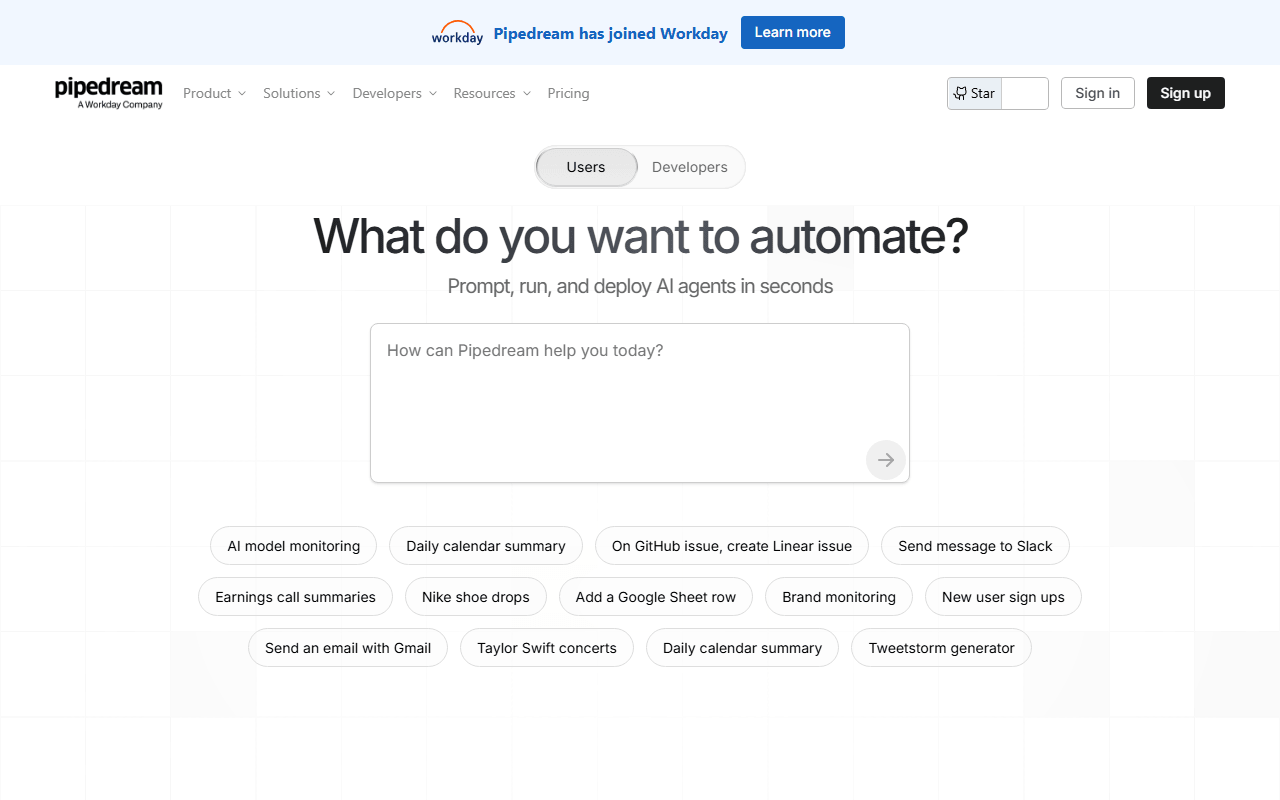
- Free plan (as of July 2026)
- United States
- Best for:
- Developers who want code inside their workflows and prefer a hosted platform to a server
- The catch:
- Pipedream renders its pricing client-side, so we could not confirm the exact free-tier numbers first-party, and it is code-first, which is a wall for non-developers.
Compared to Zapier
- Advantage: Drop into Node.js or Python at any step, well beyond Zapier's Code step
- Advantage: Credit billing tied to compute, not a task per step
- Advantage: Open source component registry you can inspect and extend
- Tradeoff: Code-first, so far less approachable than Zapier for non-developers
- Tradeoff: Exact free-tier limits render client-side and could not be verified
- Worth knowing: Hosted only, with no self-hosting
Completely free and open source, unbeatable when automations touch hardware
Node-RED is the free pick when your automations reach past SaaS into the physical or local world. It is Apache-2.0, maintained by the OpenJS Foundation, and never charges you, running happily on anything from a server to a Raspberry Pi. For sensors, MQTT, local files, and IoT, it does things Zapier cannot, and it does them for nothing.
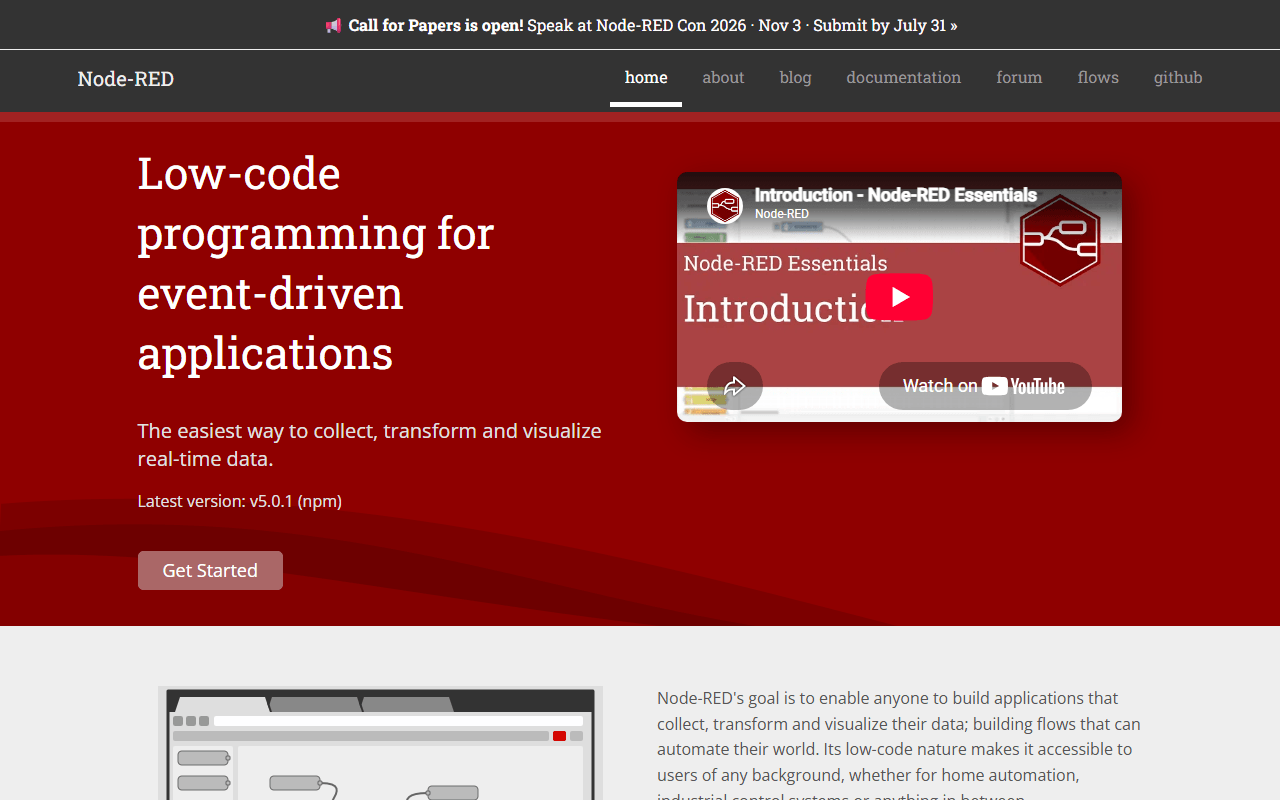
- Completely free (as of July 2026)
- United States
- Open source (Apache-2.0)
- Best for:
- Makers and developers automating hardware, IoT, and local systems on a free, open source engine
- The catch:
- It is self-host only and leans technical, and pure SaaS-to-SaaS work relies on a community node palette rather than Zapier's curated connectors.
Compared to Zapier
- Advantage: Completely free and open source with no usage meter at all
- Advantage: Handles hardware, IoT, and local systems Zapier cannot reach
- Advantage: Runs on tiny hardware like a Raspberry Pi
- Tradeoff: Self-host only and more technical than Zapier's hosted signup
- Tradeoff: SaaS connectors come from a community palette, not a first-party catalogue
- Worth knowing: No hosted multi-user workspace out of the box
A private, self-hosted agent system for watching the web and acting on it
Huginn is on this list with a caveat: it is not a broad Zapier-style connector platform, it is a self-hosted agent system for monitoring and reacting. If your reason for leaving Zapier is that you want to scrape pages, watch feeds, and fire alerts on your own server with your data staying private, Huginn does that job well, for free, under an MIT license. Pair it with a broader tool if you also need lots of SaaS connectors.
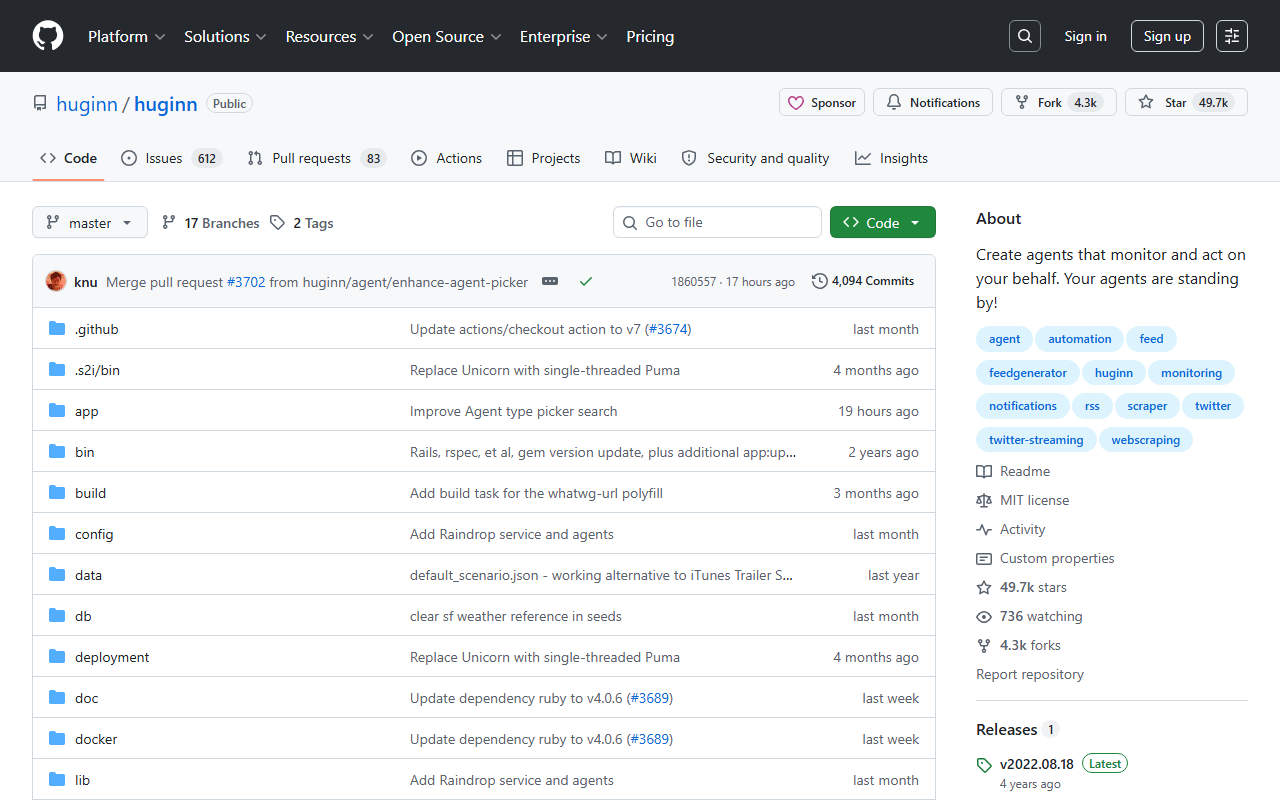
- Completely free (as of July 2026)
- United States
- Open source (MIT)
- Best for:
- Developers who want private, self-hosted monitoring and alerting agents rather than SaaS-to-SaaS connectors
- The catch:
- It is a Ruby on Rails app with a database to run and maintain, the interface is dated, and its SaaS connector coverage is nothing like Zapier's.
Compared to Zapier
- Advantage: Free and open source under MIT, self-hosted with data that never leaves your server
- Advantage: Strong at scraping, monitoring, and alerting workflows
- Advantage: Fully hackable and code-friendly for developers
- Tradeoff: Not a broad connector platform, so it will not replace most Zaps directly
- Tradeoff: Ruby on Rails plus a database to set up and maintain yourself
- Tradeoff: Dated, config-driven interface next to Zapier's polish
How to choose
Decide first whether you can run a server. If you can, self-hosted n8n is the most capable free replacement and bills per whole run instead of per step, with Activepieces close behind if you want a friendlier open source builder and Node-RED if your automations touch hardware or IoT. If you will not host anything, Make has the strongest free cloud tier, and Pipedream fits you if you would rather write a little code than click. Huginn is the developer's pick for private web-monitoring agents. Match the tool to your comfort with servers and code, because that decides more than any feature list.