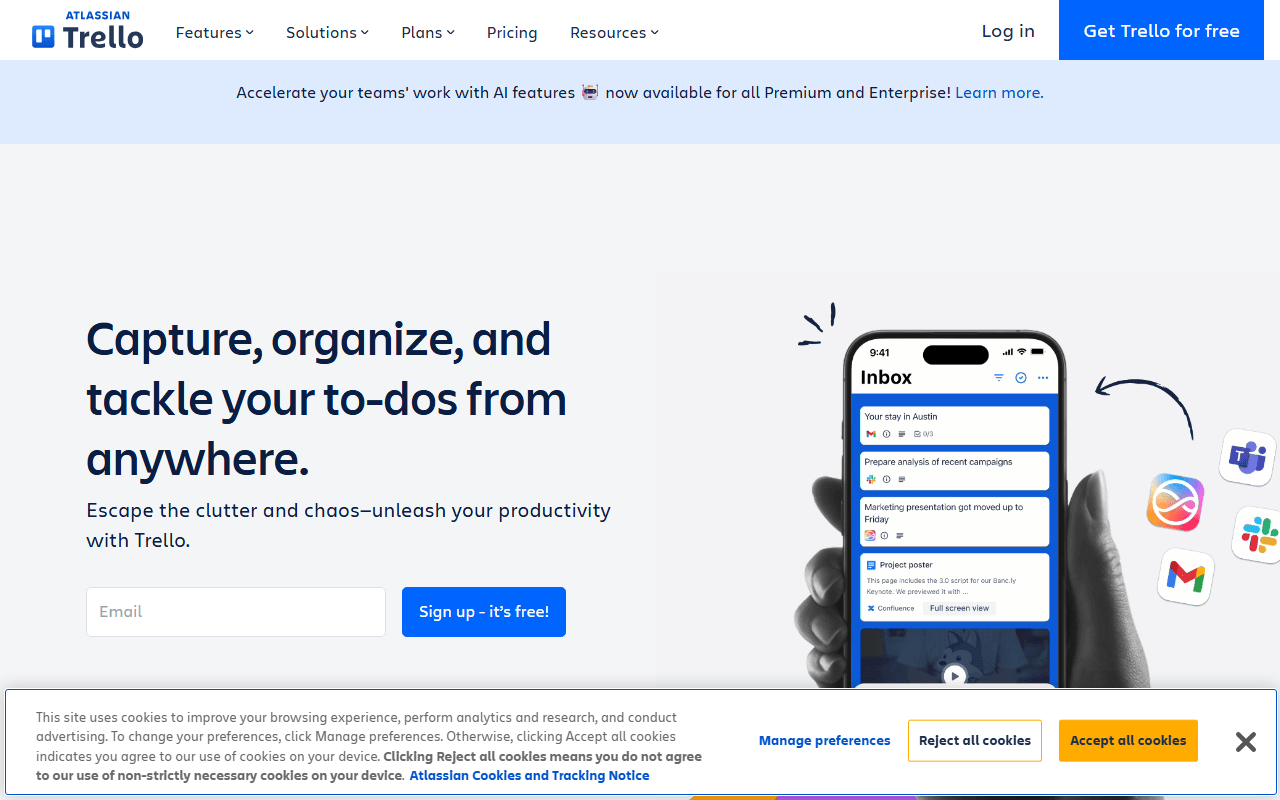

Cards you drag, and not much else to learn
Trello is a kanban board: lists of cards you drag from "To do" to "Done". Cards hold checklists, due dates, attachments, and comments, and Power-Ups bolt on extras like calendar views and GitHub links. It is owned by Atlassian, the company behind Jira.
Small boards, new collaborators, zero training
- Small teams and personal projects that just need a shared visual board
- People who found Jira or Asana heavier than the work they manage
- Anyone onboarding non-technical collaborators; there is nearly nothing to learn
Free to 10 boards, then priced at $5 a seat
Trello is freemium. As of July 2026, the free plan includes unlimited cards, up to 10 boards per workspace, up to 10 collaborators per workspace, unlimited Power-Ups, 250 automation runs a month, and file attachments up to 10MB each. Standard ($5/user/month billed annually) lifts the board cap and raises attachments to 250MB. Premium ($10/user/month) adds calendar, timeline, and dashboard views.
The 10-collaborator wall, and three smaller limits
- The 10-collaborator cap per free workspace is the wall most teams hit first
- No built-in Gantt, timeline, or reporting without Premium or Power-Ups
- Subtasks are just checklists; dependencies and workload views do not exist
- 250 automation runs a month disappears quickly once you rely on Butler rules
Still the least-friction board, until you are 11 people
For a simple shared board, Trello is still the least-friction option going. If your team is bigger than 10 people or your process needs sprints and dependencies, start with ClickUp or Plane instead.
Reader reviews
What people who actually use Trello think of it.
No reviews of Trello yet. If you have used it, yours would be the first.
The useful part is the specifics: what you used it for, and where it got in your way.
Loading...